
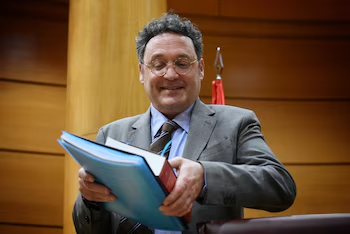
The Prosecutor’s Office has formally requested the annulment of the conviction handed down by the Supreme Court against Álvaro García Ortiz, the former State Attorney General. This appeal is significant as it follows a political and legal controversy stemming from the leak of a confession by Alberto González Amador, a partner of Isabel Díaz Ayuso, who has been prosecuted for tax fraud.
Claim of Fundamental Rights Violations
In its appeal, the Prosecutor’s Office asserts that the judicial process infringed upon five fundamental rights of García Ortiz. The appeal argues that he acted responsibly in providing information that was already in the public domain, aimed at countering “false criminal accusations” that surfaced in the media.
Biased Evidence Assessment
A central contention of the appeal is that the Supreme Court’s assessment of the evidence was “biased and unreasonable.” The Prosecutor’s Office emphasizes that testimonies from journalists who denied receiving information from the prosecutor were not adequately considered. This neglect, they argue, undermines García Ortiz’s right to the presumption of innocence.
Judicial Interpretation Concerns
The appeal directly criticizes the judges who signed the ruling, claiming their interpretations regarding journalistic source protection resulted in moral coercion for informants. This stance is deemed a threat to judicial integrity, as it may weaken the protection of those investigated if journalists are unable to disclose the origins of their information.
Questionable Evidence and Context
Among the evidence criticized was a four-second call made to García Ortiz by a journalist, which the defense argues does not constitute definitive proof of a leak. The Prosecutor’s Office asserts that such a brief call, which ended up going to voicemail, aligns with García Ortiz’s claim of being otherwise occupied at that moment.
Additionally, the appeal challenges the Supreme Court’s judgment regarding a supposed “small circle” of individuals who had access to the leaked information. It argues that the relevant email circulated widely, undermining claims of restricted access.
Ambiguous References in the Ruling
The Supreme Court’s reference to an “environment” surrounding García Ortiz raises further questions, as the Prosecutor’s Office emphasizes that there was no clear definition of who this group comprised or how they accessed the leaked information. This vagueness is deemed inappropriate for a criminal sentence.
Rights to Privacy and a Fair Process
The Prosecutor’s Office also argues that there was a violation of García Ortiz’s right to privacy and his confidentiality of communications. The search conducted in his office is characterized as “illegal” due to indiscriminate and disproportionate methods employed by the investigating judge.
The Public’s Right to Information
Lastly, the appeal questions the conviction based on a press release issued in March 2024 as a response to misinformation. The Prosecutor’s Office argues that the conviction undermines the public’s right to know and challenges the principle of legality since the details conveyed were already public knowledge.
The Path Ahead
As the Constitutional Court deliberates whether to admit the appeal, it enters a crucial debate concerning the balance between public information, journalistic confidentiality, and the rights of individuals within criminal proceedings. The legal ramifications of this case could set significant precedents for the future of judicial processes and media interactions in similar contexts.