
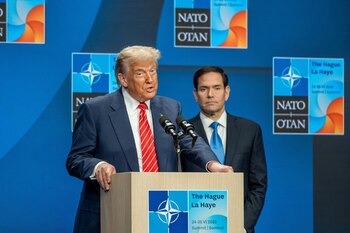
Reevaluating NATO: U.S. Concerns Over European Military Support
During a recent Fox News interview, U.S. Secretary of State Marco Rubio emphasized the need for the United States to reassess its NATO participation in light of certain European allies’ restrictions on military support, particularly regarding operations against Iran. Countries such as Spain, France, and Italy have denied the U.S. access to their military infrastructure for these operations, raising pivotal questions about the future dynamics within the transatlantic alliance.
The Growing Divide: European Refusals
Rubio pointed to Spain’s refusal to allow the use of American bases located in Rota and Morón for strikes against Iran. Spanish Defense Minister Margarita Robles defended this decision, asserting that it does not signify a deterioration of Spain’s commitment to NATO or collective defense responsibilities. Instead, she maintains that the country is adhering to its national obligations.
The U.S. has repeatedly expressed discontent with the lack of support from several European nations, particularly in light of recent military actions that have reportedly resulted in significant civilian casualties. Reports indicate that military operations have led to over 2,000 deaths, with independent organizations estimating the toll to be higher, including many innocent victims.
Doubts About Military Alliance
Rubio’s critical assessment raises vital inquiries about the current benefits of NATO. He questioned whether the alliance still functions as a reciprocal relationship or if it has become one-sided, with the U.S. shouldering the majority of the burden for European defense while receiving limited support in return. His poignant statement—”We have troops in Europe to defend it, but when we need their help, is your answer no?”—encapsulates growing frustrations among U.S. policymakers.
A Historic Strategic Partnership
Despite his criticisms, Rubio acknowledged NATO’s historical value to American interests, facilitating a military presence in Europe that enables broader global power projection. However, he stressed the impracticality of maintaining such a presence if the U.S. cannot count on its allies to respond during critical moments.
Spain’s Perspective and NATO’s Future
In defense of Spain’s position, Robles reinforced the notion that the country does not intend to abandon its obligations within the Atlantic framework. This assertion highlights a potential disconnect between U.S. expectations and European national interests, which could further strain the alliance.
The tensions surrounding NATO have intensified, especially in the backdrop of a military offensive in Iran and the accompanying humanitarian crisis. While the U.S. advocates for a collective approach to defense, many European nations appear hesitant to engage in operations that extend beyond their national interests.
Reassessing NATO’s Role
In conclusion, the recent developments urge a thorough reevaluation of NATO’s structure and mechanisms in alignment with U.S. foreign policy objectives. As Washington navigates the complex web of military operations and responses from its allies, a clearer understanding of NATO’s purpose in contemporary geopolitics becomes increasingly vital. The question remains: can NATO adapt to meet new challenges, or is a significant reshaping of the alliance on the horizon?
As global dynamics continue to evolve, the future of NATO and its member states will hinge on their ability to foster a more balanced, collaborative defense strategy that meets the needs of all involved.