
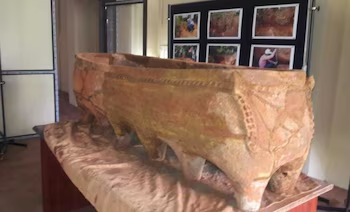
Unveiling the 12-Legged Sarcophagus
A remarkable discovery in Pallavaram, Tamil Nadu, has captured the attention of archaeologists worldwide. A team from the Archaeological Survey of India unearthed a terracotta sarcophagus measuring approximately 2 meters in length, characterized by an unprecedented design featuring 12 legs. Dating back to the 3rd century BC, this artifact reveals insights into the elaborate funerary practices of ancient megalithic communities in the region.
Significance of the Discovery
This terracotta sarcophagus is particularly striking due to its unique structural design, which sets it apart within the local archaeological record. The creation of such an intricately designed piece demonstrates the technical expertise that ancient inhabitants mastered in ceramics. Moreover, the presence of this artifact indicates a complex social organization and the sophistication of funerary rituals among these communities.
Experts noted that the sarcophagus features three holes at its base, likely used for fastening ropes to assist in transporting it during burial rituals. The piece, measuring approximately 170 centimeters in length and 45 centimeters in width, was discovered about two meters underground, further hinting at its significance.
Cultural and Historical Context
This discovery reinforces the notion that the ancient societies in Tamil Nadu were advanced in their methods of working with fired clay. The construction of such a funerary container showcases a settled and organized society with specialized technological knowledge. It also suggests the existence of long-distance trade networks within southern India during the 3rd century BC, linking various regions through cultural and economic exchanges.
By examining the archaeological context, researchers gain invaluable insights into the well-being and social complexity of these ancient communities. The sophisticated design of the sarcophagus, combined with its excellent condition, is expected to yield crucial information regarding social hierarchies and funerary customs prevalent during that period.
Scientific Analysis and Research Future
Moving forward, the research team plans to employ thermoluminescence dating techniques to accurately determine the age of the sarcophagus. This method will help verify the initial estimates regarding its dating based on stylistic features and other archaeological contexts.
The detailed analysis will explore the transmission of technical skills and the social structure of megalithic communities. The symbolic or ritual significance of the 12-legged design remains to be fully understood, but it is expected to enhance knowledge around ancient beliefs and practices.
As research continues, discoveries like these will deepen our understanding of Tamil Nadu’s material culture and the complexities surrounding funerary practices and ancient trade networks. The novelty of the 12-legged sarcophagus not only highlights the ingenuity of the past but also opens new avenues for exploring the evolution of complex civilizations in South Asia.