
The Invisible Web: Singapore’s Role in Global Telecommunications
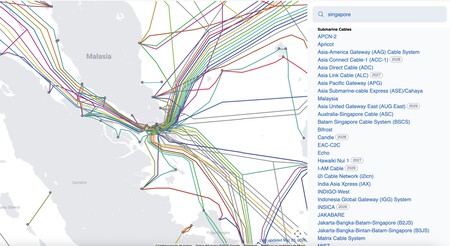
In today’s interconnected world, where the vast majority of information is stored in the cloud, the intricate web of global communications may seem invisible. However, underlying these connections are submarine cables, responsible for an astonishing 97% of intercontinental traffic. A glance at the global submarine cable map reveals a landscape filled with tangled connections, with Singapore standing out as one of the most congested nodes.
Geographical Importance
Singapore’s geographical positioning plays a significant role in its telecommunication dominance. Nestled on the maritime route between Europe, the Middle East, and East Asia, it boasts a critical location that has evolved into a communications hub. The island aligns perfectly with the flow of global trade and data, creating an essential junction for numerous submarine cables.
Singapore: The Connectivity Hub of Asia
Recognized as Asia’s prime connectivity hub, Singapore links East Asia, South Asia, the Persian Gulf, and Europe. It is home to approximately 30 active cables and numerous additional lines under development, all converging within just 720 square kilometers of territory, according to TeleGeography. To efficiently manage such a multitude of cables, Singapore has designated specific landing areas, organizing deployments to maintain a clean underwater environment.
The Role of the Singapore Internet Exchange
At the heart of this network lies the Singapore Internet Exchange (SGIX), situated on the Equinix campus. Acting as a crucial exchange point, SGIX facilitates rapid data transfer among hundreds of operators across Asia. The ultra-low latency and redundant capacity ensure that during crises, such as the Red Sea cable disruptions in 2022, traffic can be swiftly rerouted.
A Historical Backdrop: The Footprint of British Influence
Sufficiently establishing itself as a global hub required historical groundwork. The British East India Company recognized Singapore’s strategic location in 1819, laying the foundation for its future significance. The Strait of Malacca, which bounds Singapore, is a vital conduit, witnessing the passage of over 80,000 ships annually. This facilitates not only maritime trade but also the installation of submarine cables connecting the Eastern and Western hemispheres.
The Surprising Origin of Submarine Cables: Gutta-Percha
The story of Singapore’s telecommunications prominence involves a unique material: gutta-percha, derived from the sap of the Palaquium gutta tree. When Scottish surgeon William Montgomerie encountered this material in 1822 while serving the British East India Company, he showcased its properties — waterproof, impact-resistant, and easy to mold — as ideal for insulating cables.
The Rise and Fall of Gutta-Percha
With the first submarine cable laid in 1851, the demand for gutta-percha soared as it became integral to communication networks. However, this came at an environmental cost, leading to unsustainable harvesting practices that nearly wiped out the gutta-percha tree in the region by the late 1800s. Fortunately, the development of synthetic materials in the 1930s and 1940s eventually marked the decline of gutta-percha in undersea cables, but not before it had shaped global connectivity.
Conclusion: Singapore’s Enduring Legacy
The evolution of telecommunications in Singapore is a testament to its strategic geographic advantages and historical milestones. The interaction between the need for durable cable insulation and the English colonial foresight has founded a hub that has only intensified in significance. Today, Singapore stands as the unseen heart of global telecommunications, showcasing a remarkable journey from the roots of undersea cables to the fiber-optic networks that dominate modern connectivity.