
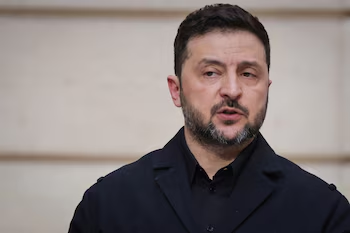
Zelensky Accuses Russia of Sharing Intelligence with Iran to Target US Assets
Kyiv has made serious allegations against Moscow, accusing it of sharing intelligence with Iran that enables Iranian forces to launch precise attacks on US troops and military assets in the Middle East. President Volodymyr Zelensky presented these accusations after receiving a report from Oleg Ivashchenko, the head of Ukraine’s Military Intelligence Service (GUR). Zelensky characterized the evidence of this cooperation as “irrefutable,” suggesting that it not only exacerbates the ongoing conflict in Iran but also prolongs the war in Ukraine.
Russia’s Intelligence Capabilities
Zelensky emphasized that Russia is using its own signals and electronic intelligence along with information gleaned through its relationships with Middle Eastern partners to bolster Iranian military capabilities. He stated, “Russia uses its own signals intelligence and its electronic intelligence capabilities,” which empowers Iran to “attack more and with more precision.” Such partnerships are deemed “destructive activities” that must be curtailed, according to Zelensky, who insists that every respectable nation seeks security to avoid significant crises.
Context of Intelligence Sharing
Kyiv’s bold claims come after reports emerged in early March indicating that Russia had been providing Tehran with locations of US warships and aircraft since the onset of military conflicts involving Washington, Israel, and Iran. Major news outlets like The Washington Post, CNN, and NBC confirmed these reports. One US official described Russian support for Iran as “pretty comprehensive,” though the Kremlin has not directly denied these allegations. Instead, spokesperson Dmitri Peskov stated that Moscow continues to maintain a “dialogue” with Tehran.
Military Collaborations Between Russia and Iran
The relationship between Russia and Iran has deepened significantly since the 2022 invasion of Ukraine. Iran has provided Russia with hundreds of Shahed drones, which have been heavily utilized against Ukrainian infrastructure and cities. In exchange, Moscow has supplied Tehran with satellite imagery and technical enhancements for Iranian drones, including tactics modeled on its military operations in Ukraine. Analysts have noted that Iranian military strategies in the Gulf mirror Russian tactics, often involving drone waves to overwhelm radar defenses, followed by precise missile strikes.
US Responses to Intelligence Sharing
The White House has opted not to deny the existence of this intelligence-sharing arrangement, although officials have minimized its impact. According to White House spokesperson Karoline Leavitt, this cooperation is “clearly not making any difference” in the operational successes of US and Israeli forces against Iranian targets. Defense Secretary Pete Hegseth reaffirmed that the US is diligently monitoring the situation and incorporating these intelligence assessments into their battle strategies.
New Military Infrastructure in Belarus
Zelensky also issued warnings about new Russian military infrastructure being established in Belarus and occupied regions of Donbas. He claims Moscow is preparing to install ground stations in Belarus for long-range drones, which have been used to attack Ukrainian cities like Kyiv. “We have destroyed the relevant antennas, and there will be tangible responses,” he cautioned. He also hinted at a potential major Russian offensive, urging the population to heed air warning sirens.
Slow Progress in Negotiations
These developments unfold against a backdrop of sluggish negotiations between Moscow and Washington regarding Ukraine. The strategic cooperation between Russia and its adversaries raises pressing questions for Western foreign policy experts about whether Washington can effectively negotiate with Putin while simultaneously containing an alliance that spans from the Ukrainian front to the Persian Gulf.
Zelensky’s assertions and the implications of this intelligence sharing highlight the complex and often perilous geopolitical landscape that continues to evolve in the wake of ongoing conflicts.