
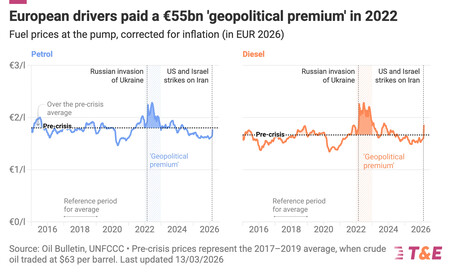
Every time you start your car in the morning or a factory turns on its machines in Europe, the bill rises at the rate of conflicts that occur thousands of kilometers away. In 2023 alone, the European Union spent 427 billion euros on energy imports, creating a significant financial drain exceeding 1,000 million euros per day.
Understanding the Geopolitical Bonus
This chronic dependency forces the EU to pay what the Transport & Environment organization (TEA) calls a “geopolitical bonus.” Current conflicts, such as the crisis in the Middle East, threaten to replicate the worst shortages and volatility seen in past years, making it imperative for governments to respond quickly to mitigate the impact.
Spain’s Strategic Oil Release
To cushion these economic blows, the Government of Spain has authorized the release of up to 11.5 million barrels of oil from its strategic reserves through the Ministry for the Ecological Transition (MITECO). This measure represents Spain’s 2.9% contribution to the International Energy Agency’s (IEA) historic plan to inject 400 million barrels into the global market.
The release aims to circulate the equivalent of four days of national oil consumption, reducing price volatility while preventing panic in response to shortages triggered by geopolitical tensions in the Strait of Hormuz and the war in Iran.
The Toll on European Vulnerability
The repercussions of these conflicts are manifesting in the wallets of European families and the competitiveness of businesses, creating significant strain in an already vulnerable energy sector. High crude oil prices have previously led to energy gaps soaring over 604 billion euros, with daily expenses rising by 500 million euros in 2022.
Impact on Consumers
- Drivers are Feeling the Heat: According to TEA analysts, if crude oil maintains around $100 per barrel, EU motorists could face an additional 55 billion euros in costs annually. This translates into a potential increase of about 220 euros a year for each driver, with gas prices potentially hitting 2 euros per liter.
- Industrial Strain: As the IEA responds to volatility by releasing strategic reserves, experts warn that oil barrel prices could rise to $200, pushing European gas futures up by 30% in a single day. This unpredictability puts entire factories at risk of insolvency.
- Fiscal Limitations on Governments: Today, European governments have less fiscal room to maneuver due to accumulated deficits. Nonetheless, there are discussions in Brussels about breaking historical norms to intervene in the market through tax cuts and caps on electricity tolls.
The Financial Firewall of Electric Vehicles
Amid this chronic vulnerability, the transition to electric vehicles (EVs) is acting as a financial buffer against the crisis. TEA highlights that the current energy crisis will affect gasoline vehicles five times more than electric ones. For instance, traveling 100 kilometers in a typical gasoline car could cost 14.20 euros, while recharging an EV only amounts to 6.50 euros.
By 2025, electric vehicles on European roads have already prevented the import of crude oil worth 2.9 billion euros. Emphasizing climate ambitions and promoting widespread EV adoption can avoid an estimated 45 billion euros in foreign crude oil costs over the next decade.
The Geopolitical Paradox
This situation has birthed an unprecedented geopolitical paradox. Due to supply weaknesses, the United States has issued emergency waivers allowing India to buy Russian crude oil, which has shifted from huge discounts to commanding historic premiums. Despite these economic pressures, the European Commission remains firm in its stance against importing energy from Russia.
The Imperative for Energy Transition
The current crisis serves as a painful reminder of Europe’s reliance on fossil fuel imports. Experts like TEA’s Antony Froggatt argue that Europe must prioritize electric vehicles, heat pumps, and renewable energies to prevent similar crises in the future. As long as economies are tied to the unstable Persian Gulf routes, the economic security of European citizens remains at the mercy of conflicts beyond their borders.
Accelerating the transition away from fossil fuels is no longer just a climate imperative; it stands as the most pragmatic choice for both national security and economic stability in Europe.