
## Understanding the Impact of AI on Job Markets
Artificial intelligence (AI) has long been heralded as a potential disruptor of job markets, with forecasts suggesting it could eliminate millions of qualified positions. Dario Amodei, the CEO of Anthropic, indicated that AI could impact half of entry-level administrative roles in the near future. Mustafa Suleyman, head of AI at Microsoft, made an even bolder prediction, suggesting that a majority of professional work could face replacement within a year and a half.
### The Latest Study: A Reality Check
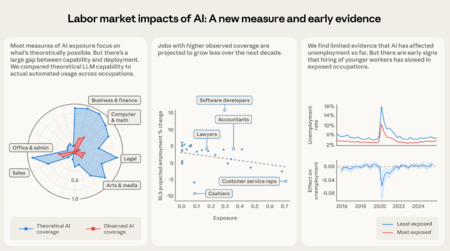
However, a new study from Anthropic, led by economists Maxim Massenkoff and Peter McCrory, challenges these dire predictions. While acknowledging the risks, their research calls for a more nuanced view. They introduced a metric termed “observed exposure,” which assesses what AI is currently accomplishing in professional settings rather than merely theorizing about its potential capabilities.
### The Gap Between Theory and Practice
In specific fields like computer science and mathematics, language models theoretically could perform 94% of the tasks. Yet, in practice, AI such as Claude currently handles only about 33% of these tasks. The disparity is similarly stark in areas like office automation, where the theoretical capacity nears 90%, but actual implementation remains significantly lower.
For instance, managing prescription refills is a task easily automated by AI, yet the study has not observed such activities being executed by Claude. Various barriers, including legal restrictions and the necessity for human validation, hinder AI from automating these tasks.
### Who Bears the Brunt of AI Exposure?
The study identifies roles with the highest “observed exposure” to AI, ranking computer programmers (74.5%), customer service representatives (70.1%), and data entry personnel (67.1%) at the top. On the flip side, certain jobs—such as cooks, mechanics, and lifeguards—have zero exposure due to their reliance on physical presence, indicating that AI is not yet ready to replace these roles.
Interestingly, the demographic profile of those most at risk diverges from common assumptions. The data reveals that these workers tend to be 16% more likely to be women, earn 47% more on average, and usually possess higher educational levels. Contrary to expectation, it’s not the warehouse worker but rather financial analysts, lawyers, and software developers facing the greatest risks.
### Unemployment Trends and Young Workers
One significant finding of the research concerns unemployment rates. Since ChatGPT’s emergence in late 2022, there has been no statistical evidence indicating a systematic rise in unemployment among those most exposed to AI. The study suggests that the impact is “indistinguishable from zero.” The Bureau of Labor Statistics does predict a slower growth rate for these vulnerable roles until 2034; therefore, monitoring trends remains crucial.
However, a concerning trend has emerged among workers aged 22 to 25. Their entry rate into high-exposure jobs has declined by approximately 14% since the advent of ChatGPT, attributed more to a slowdown in hiring than layoffs. Reasons vary but include remaining in current positions longer or pursuing opportunities in different sectors.
### Limitations and Caution
Critics, including analysts from Forbes, highlight the study’s limitations, noting it focuses on Claude’s specific use and overlooks broader AI applications across the economy, including platforms like ChatGPT and Microsoft Copilot. The study’s authors recognize this limitation but emphasize that the conclusion—that AI has yet to fulfill its theoretical potential—holds validity.
### Should We Be Concerned?
Despite the reassurances from this study, experts recommend caution. The analysis indicates that the impact of AI may unfold gradually and quietly, complicating the task of detecting its consequences until it’s too late. Unlike sudden shocks like COVID, the ramifications of AI could be slow and intertwined with other economic factors.
Moreover, if the gap between theoretical capacity and actual use narrows, it is likely to impact the most vulnerable groups—those currently earning higher wages and possessing better education levels.
### Conclusion
In summary, while fears about mass job displacement due to AI may be exaggerated, the realities of its adoption remain complex. Monitoring trends is imperative, as the impact of AI continues to evolve, potentially altering the landscape of work in unforeseen ways.