
Kicillof’s Improved Salary Offer: An Overview
The Kicillof government is actively working to reach a joint salary agreement with various public administration unions in Buenos Aires. Following significant protest actions against the administration of Javier Milei, the government has reassessed its previous offer, which included a mere 3% salary increase for March. In an attempt to appease discontent among educators, Kicillof introduced a revised proposal.
A New Salary Proposal for Educators
During a formal meeting that included Pablo Lopez, the Minister of Economy, the Kicillof administration presented an updated salary proposal. The government has proposed increasing salaries by 5% starting in March, up from the initial 3%. Additionally, there is a planned rise of 2.5% for April, supplementing the 1.5% increase granted in February.
According to the Buenos Aires Teaching Unity Front (FUDB)—which includes various unions such as SADOP and SUTEBA—the new salary scale reveals substantial increases for teachers. For instance, the initial monthly salary for a graduate teacher will be $800,084 in March and $850,053 in April. Similarly, a full-time undergraduate teacher will earn $1,600,168 in March and $1,700,106 in April.
Context of the Proposal
The salary negotiations emerged in a climate of turmoil amid various protests, particularly from educators who orchestrated actions that delayed the start of classes in Buenos Aires public schools. Notably, Peronism’s internal discussions have been affected by these actions, with members emphasizing the necessity of fairly compensating teachers to prevent further erosion of their purchasing power.
Factors Influencing Negotiations
Various stakeholders are scrutinizing the salary offer closely. Educator unions appear to view the new proposal positively, with informal discussions suggesting a favorable outlook towards acceptance. The unions had previously deemed the 3% proposal insufficient, prompting last week’s strike actions.
A significant focus of the negotiations is a monitoring clause, which will allow parties to evaluate the salary agreement’s progress by May 2026, and a reopening clause that ensures negotiations can resume sooner if economic conditions shift dramatically.
Government’s Commitment to Education
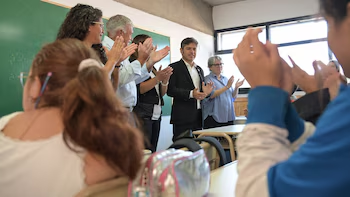
Amid this tumultuous backdrop, Kicillof recently inaugurated the 300th school since his governorship in Berazategui. He reaffirmed his commitment to providing free, quality public education, while also targeting administrative improvements that may serve to counteract the impact of Milei’s policies.
In conclusion, the Kicillof administration is navigating a complex landscape of labor negotiations aimed at improving educators’ salaries in Buenos Aires. As the unions evaluate the latest salary proposal, the outcome will significantly impact the educational framework and the broader political debate surrounding public sector welfare in Argentina.