
Hezbollah’s Defiance Against the Lebanese Government and Israel
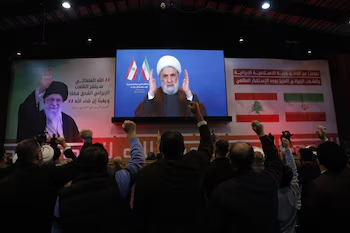
According to L’Orient-Le Jour, Naim Qassem, the Deputy Secretary-General of Hezbollah, has publicly criticized the Lebanese government for capitulating to external pressures. In a recent address following renewed Israeli strikes in Lebanon, Qassem articulated a firm stance, declaring, “We will never surrender to the enemy.” He voiced his objections to government initiatives aimed at disarming Hezbollah, underscoring the group’s commitment to resistance as long as Israeli aggression persists.
Claims of Sovereignty and Resistance
During his speech, Qassem emphasized that it is the responsibility of the Lebanese authorities to safeguard national sovereignty and protect their citizens. He invoked the “right to resist,” asserting that it must continue until acts of aggression cease and Israeli forces withdraw from Lebanese territory. He contended that recent rocket fire from Hezbollah was not the root cause of escalating tensions but rather part of a broader Israeli strategy in coordination with the United States.
The Context of Rising Hostilities
The backdrop of Qassem’s remarks includes heightened tensions following the assassination of Iranian Ayatollah Ali Khamenei. He stated that Hezbollah’s military actions aim to counteract “Israeli-American aggression in Lebanon.” Qassem challenged both the Lebanese government and society by questioning whether the actual issue lies with Hezbollah’s military presence or the ongoing “violations of Lebanese sovereignty by Israel.”
Government Reactions and Internal Divisions
Lebanon’s President Joseph Aoun weighed in by declaring the decision to restrict Hezbollah’s military operations as “irreversible.” He asserted that the Council of Ministers is empowered to prohibit military activities that exist outside state law. This move was formalized following an Israeli offensive triggered by rocket attacks from Lebanon, which were themselves a response to the assassination of Khamenei.
Impact on the Lebanese Society
The ongoing bombing campaign has exacerbated existing political and social tensions within Lebanon, leading to numerous fatalities. Qassem remarked that Israeli attacks represent an “aggression against all of Lebanon,” attributing the escalation of conflict solely to Israel. He reaffirmed Hezbollah’s commitment to military action in defense of Lebanese sovereignty, despite governmental constraints and international calls for disarmament.
A Nation at a Crossroads
The ongoing friction between Hezbollah and the Lebanese cabinet introduces a complex dilemma for Lebanese society. Many political factions and social groups are currently debating the legitimacy of armed resistance outside the framework of state authority and the protection of national sovereignty from external threats. Qassem’s assertions deepen the divide with the Lebanese government, positioning Hezbollah as the protector of national defense while openly rejecting pressure from foreign powers.
As L’Orient-Le Jour indicates, the current situation reflects a critical institutional crisis in Lebanon, amidst a high-stakes military offensive environment and intricate regional alliances. The latest developments underscore the pressing challenges facing Lebanon in governance and security, making this one of the most tumultuous periods in recent history.
The implications of these events will undoubtedly shape Lebanon’s future trajectory as the nation grapples with internal divisions and external aggressions.