
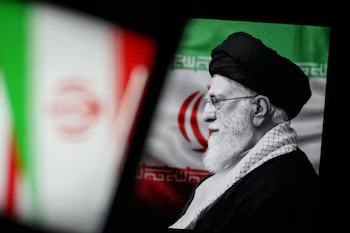
The Death of Khamenei: What Lies Ahead for Iran, the Middle East, and the World
On February 28, while much of the world slept, the United States and Israel launched the most ambitious military operation in the Middle East since the Iraq invasion in 2003. Within hours, Ayatollah Ali Khamenei, the iron-fisted leader of Iran for nearly four decades, was dead, taking with him the Defense Minister, the commander of the Revolutionary Guards, and the Secretary of the regime’s Security Council.
A Turning Point in Iranian Politics
Donald Trump announced the operation in the early morning, addressing the Iranian people with a message: “Take control of your government. It will be yours. This is probably your only chance in generations.” In retaliation, Iran quickly launched missiles and drones at Israel and U.S. military bases in Bahrain, Kuwait, Jordan, Qatar, and the UAE, expressing its anger through Foreign Minister Abbas Araghchi: “This is a war of choice by the U.S., and they will have to pay for it.”
The Historical Significance of Khamenei’s Departure
To grasp the impact of Khamenei’s death, it is essential to recognize who he was—not merely a leader but the very embodiment of the Iranian regime. Danny Citrinowicz, former head of Israel’s Iran intelligence department, aptly summarized: “Khamenei defined the system.” His rigid ideology and strategic patience shaped a confrontational Iran both externally and internally, maintaining deep involvement in regional influences.
The Power Vacuum and Its Implications
Khamenei’s death does not signal the end of the Islamic Republic, as many might misinterpret. Linda Robinson of the Council on Foreign Relations notes that killing Khamenei does not equate to regime change; the Revolutionary Guard is the regime itself. The IRGC’s extensive membership and deep roots in the Iranian economy ensure its continuance, backed by a generation bred in real battlefields.
Citrinowicz and others agree that the removal of Khamenei leaves a leadership void that remains to be filled. The consequences of this absence could lead to instability, both within Iran and across the Middle East.
Emerging Leadership amid Uncertainty
The immediate aftermath saw Ali Larijani, head of the Iranian Defense Council, announce the formation of a temporary leadership council—signaling no lack of preparedness. Three key figures are stepping into central roles: Mohammad Baqer Qalibaf, President of the Parliament; Ali Larijani, and Ali Shamkhani, head of the National Security Committee. Their military backgrounds are crucial, as they navigate Iran’s new reality in an active conflict setting.
Iranian Military Responses and Regional Dynamics
As Iran retaliated against U.S. bases, observers cautioned against viewing their actions as purely impulsive anger. Alex Plitsas, a former Pentagon counterterrorism official, contended that Iranian responses showcased a rational decision-making process aimed at moderating escalation.
Meanwhile, Hezbollah, once Iran’s formidable ally, finds itself weakened and unable to act promptly as it has in the past. Elisa Ewers, a senior researcher, states that the group is in no position to retaliate immediately, marking a significant shift in regional dynamics.
The Broader Geopolitical Landscape
Khamenei’s assassination comes during a unique moment of isolation for Iran. Historically supported by both Russia and China, Tehran now faces condemnation without concrete military backing from its allies. Maloney highlights that many Gulf nations, fearful of potential chaos in Iran, have condemned its actions, suggesting an unwillingness to embrace a collapsing regime.
The looming question remains: what happens if the Iranian regime neither collapses suddenly nor manages to reconstitute itself? The potential for civil unrest among various ethnic minorities could destabilize the entire region, impacting nations like Turkey, Iraq, and Pakistan.
Conclusion: A New Era?
As Trump vows to continue military efforts until peace is achieved in the Middle East, experts warn that past experiences have shown wars seldom conclude as planned. While Khamenei is gone, the system he built remains, albeit precariously. The world now watches closely, as the interplay of influence shifts brought about by his death unfolds in real-time. The future remains unpredictable for Iran and the broader Middle East—a turbulent chapter in geopolitical history is just beginning.