
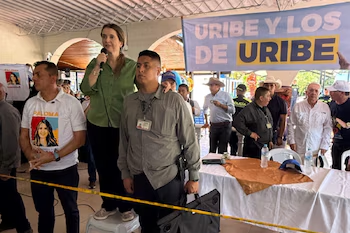
Paloma Valencia: Leading the Charge for the Great Consultation
Strong Polling Position
Paloma Valencia, a senator and presidential candidate for Colombia’s Democratic Center, is emerging as a formidable contender ahead of the interparty consultation scheduled for March 8, 2026. Recent polling data from the National Consulting Center, published in Change magazine, indicates that Valencia has garnered a significant 39.8% of voter intention among participants in the center-right consultation. This puts her well ahead of competition from notable candidates like Juan Manuel Galán, who polls at 13%, and Juan Daniel Oviedo at 12.9%.
Strategy of Moderation
The Democratic Center’s strategic move to support a moderate candidate like Valencia, distancing the party from more extreme positions, is perhaps a pivotal reason for her rising popularity. As the party’s first female presidential aspirant, her candidacy not only represents progress but also offers a center-right alternative in a fragmented political landscape. Valencia’s approach, marked by institutional support and a focus on uncontroversial policies, contrasts sharply with fellow center-left politicians like Claudia López and Sergio Fajardo, who are struggling to gain traction in the same demographic.
Key Support and Endorsements
Valencia’s candidacy enjoys the crucial backing of former President Álvaro Uribe, whose consistent presence and active support are vital in mobilizing the party’s base. As the campaign unfolds, Uribe has allowed Valencia to define her strategies independently, crucial for appealing to a moderate electorate that has historically been wary of radicalism.
Challenges Ahead
Despite her lead, Valencia faces substantial challenges. One is the expected turnout for the Great Consultation; garnering less than five million votes could signal stagnation, reminiscent of the previous right-wing consultation in 2022, which attracted 4.1 million voters. This benchmark is critical for assessing Valencia’s popularity and potential viability moving forward.
Her second challenge involves uniting the support of nine candidates within the consultation. The diversity among candidates might pose a risk to her ability to consolidate votes in the first round, particularly in attracting supporters from Galán, Oviedo, and Vicky Dávila. How well she manages this internal diversity could be decisive for her success in the elections.
Competing Profiles
Valencia’s campaign presents a clear distinction in the right-wing spectrum. She embodies a moderate, technocratic option aimed at the center, while Abelardo de la Espriella represents a more traditional right-wing stance grounded in Uribista ideology. This schism could lead to voter fragmentation, heightening the need for Valencia to solidify her voter base while avoiding the lure of De la Espriella’s more traditionalist approach.
Conclusion: The Road Ahead
In conclusion, Paloma Valencia’s rise in the political arena marks a critical moment for the Democratic Center, as she seeks to navigate through a divided electorate with strategic finesse. As the elections approach, the electorate’s response to her moderate stance and campaign strategies will play a crucial role in determining not only her candidacy but also the future of center-right politics in Colombia. The upcoming months will be pivotal as Valencia positions herself to make history in Colombian politics.