
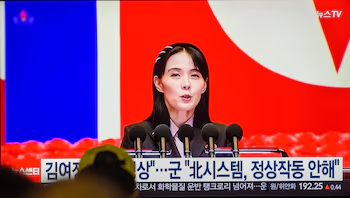
Kim Yo Jong’s Rising Influence in North Korea’s Political Landscape
The recent conclusion of the ninth congress of the Workers’ Party of Korea (WPK) has heralded a significant shift in North Korean politics, notably with the promotion of Kim Yo Jong. Her ascension within the political structure reflects not only her increasing visibility but also her integral role in guiding the regime’s future direction.
Key Developments in North Korean Politics
At the WPK congress, a pivotal event where guidelines were established for the next five years in various critical areas—economy, defense, and international relations—Kim Yo Jong’s role was a focal point. The Korean Central News Agency (KCNA) announced that she would head one of the party’s departments, although specific details regarding her responsibilities are yet to be disclosed. This promotion elevates her standing within the regime, positioning her for a more substantial influence on decision-making processes.
A Central Figure in the Regime
Kim Yo Jong’s new role consolidates her as a prominent figure in North Korea’s ruling elite. Previously serving as the deputy department director in the WPK Central Committee, she has established herself as a key spokesperson, particularly in communications directed towards South Korea. The trust bestowed upon her by her brother, Kim Jong Un, has augmented her public profile, allowing her to play a central role in shaping official government narratives.
Continuity in Leadership
The WPK congress also resulted in Kim Jong Un’s re-election as general secretary, ensuring continuity in the party’s leadership and reinforcing the Kim family’s dominance over North Korean institutions. This event served as a gathering for senior officials and provided a platform for establishing a strategic roadmap for coming years, focusing on industrial development, national security, and international positioning.
Internal Reorganization and Strategic Priorities
The KCNA details Kim Yo Jong’s appointment as part of a broader reorganization following congressional sessions. This change signifies the regime’s commitment to evaluating past policies and defining priority objectives moving forward. The secrecy that typically enshrouds the North Korean power structure adds an intriguing layer to her increasing prominence.
A Key Player in Regional Affairs
Kim Yo Jong’s consistent presence in official communications has positioned her as a primary spokesperson on regional matters, particularly regarding inter-Korean relations. Her amplified media presence and impactful statements contribute significantly to shaping both her national and international image. Analysts suggest that she may be poised as a potential successor or a significant leader in the future governance of North Korea.
The Role of the Workers’ Party
The WPK has maintained a stringent control over political discourse since its establishment in the 1940s. Kim Yo Jong’s rising profile illustrates the ongoing influence of the Kim dynasty within this framework. By emphasizing internal cohesion and unity around leadership, the KCNA has framed her new role as an endorsement of loyalty among those closest to Kim Jong Un.
Future Directions and Responsibilities
The reestablishment of responsibilities within the party, alongside the reaffirmation of Kim Jong Un’s leadership, sets a strategic action plan for the North Korean government. The congress was instrumental in consolidating alliances and addressing myriad challenges, paving the way for the desired economic policies, defense enhancements, and diplomatic strategies in an increasingly tense international environment.
Conclusion: Kim Yo Jong’s Emerging Role
Looking ahead, the KCNA confirms Kim Yo Jong’s continued involvement in the highest tiers of political decision-making. Her opinions and public addresses are anticipated to play a crucial role in the regime’s communication strategy. With the congress unveiling aspirations for improved economic development, national sovereignty protection, and enhanced international standing, Kim Yo Jong’s contributions will likely be fundamental in shaping North Korea’s state policy in the years to come.