
Countdown to March 24: The Slow March Toward an Announced Coup and the Twilight of a Country on the Brink
The Fall of Isabel Perón’s Government
By early 1976, Argentina was unraveling, and with it, the government of María Estela Martínez de Perón, the widow of Juan Perón. Following the general’s death on July 1, 1974, the country spiraled into chaos, ultimately culminating in the military coup that would usher in a dark era of dictatorship. The situation was dire—the fate was sealed. Just over six hundred days after Perón’s death, the military’s violent plans lay in wait, ready to unleash a reign of terror known as State Terrorism.
An Announced Coup
This impending upheaval was not unexpected. On Christmas Eve of the previous year, General Jorge Videla, the future head of the dictatorship, delivered a vehement speech to his troops in Tucumán. The army was battling the leftist guerrilla group ERP (Ejército Revolucionario del Pueblo) and factions of the Peronist Montoneros. Videla declared a ninety-day ultimatum for the government to eliminate “subversion,” a term he used to justify the appointment of military strategies underpinning the dirty war. With a clear deadline set for March 24, 1976, his rhetoric was laced with ominous conviction.
Argentina’s Bleeding Crisis
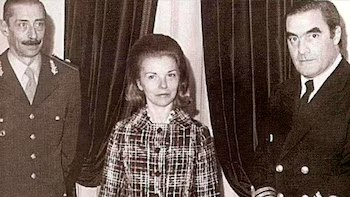
During this period, the nation bled from multiple wounds. Political dissent, economic collapse, and rampant inflation were tearing the fabric of society apart. The military was not merely an idle spectator; it was deeply involved in the political discourse. In January of 1976, Videla, alongside admirals Massera and Agosti, bluntly approached Isabel Perón, demanding her resignation. Tensions rose during this encounter; the military’s stark warnings clashed with the president’s defiance, marking the beginning of an intense battle for power.
International Complicity
The gravity of the situation caught the attention of U.S. Ambassador Robert Hill, who documented meetings with key figures, including Monsignor Pío Laghi, detailing the fraught discussions around Isabel Perón’s deteriorating reign. The military was clear: they had no intention of violating the Constitution, yet they would not tolerate her leadership any longer. The impending crisis forced the conversation towards an inevitable coup, as emphasized during various clandestine meetings organized by the military.
Economic Turmoil and Political Infighting
The economic situation disintegrated further. Under-employment, product shortages, and absurd deficit projections threatened to collapse the regional economy. Isabel struggled to maintain control within her party; the divisions became palpable as Peronist leaders demanded decisive action against the remnants of the “lopezreguismo” faction, which had links to prior civil disturbances.
As February wore on, the situation continued to escalate. The military was actively preparing, already strategizing methods for dealing with not just guerrilla factions but dissent within trade unions, political parties, and societal institutions as a whole. Calculated violence was looming on the horizon.
The Suppressed Military Summit
On February 24, the stakes reached critical levels. A clandestine military summit took place, where the top commanders aligned their strategies away from public scrutiny, amidst rising tensions both within and beyond the government. The day served as a grim confirmation that there was no going back; the coup was a mere formality waiting to be enacted.
The Inevitable Blossoms of Violence
By now, even the populace was well aware that turmoil was imminent. Cultural distractions—be they films or theatrical performances—offered solace from an ever-encroaching dread. Yet, the courage to confront the impending horror remained absent. While society sought refuge in laughter, the countdown continued toward a devastating reality.
Conclusion: An Unforeseen Abyss
Despite efforts at dialogue and possible political reprieves through early elections, reality set in with an almost poetic inevitability. The Russian novelist Dr. Chekhov once described the nature of impending doom; in this case, it wasn’t merely a distant possibility—it was a foreseen tragedy waiting to erupt. As the clock ticked toward March 24, 1976, anticipation hung heavy in the air, with an unthinkable violence lurking just below the surface.
The countdown continues, but what awaits on the other side will forever change the fate of a nation.