
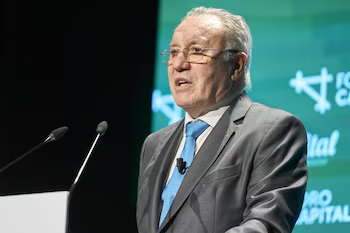
José Antonio Jainaga’s Situation: A Closer Look
José Antonio Jainaga, the president of Sidenor, finds himself at the center of a controversial judicial investigation regarding the export of steel to Israel. Facing significant allegations, Jainaga has voiced his confusion and frustration over the case, claiming that the investigation has no substantial basis.
The Judicial Investigation Explained
The current investigation revolves around whether Sidenor may have participated in illegal sales, raising concerns about smuggling and complicity in crimes against humanity or genocide. Allegations state that Sidenor allegedly sold steel to Israel Military Industries (IMSI) without the necessary authorization.
Jainaga’s defense, as highlighted by various media sources, has filed an appeal to have the search conducted at the company’s headquarters in Basauri declared void. Both Jainaga and his defense argue that the investigation lacks reasonable grounds, a sentiment echoed by the Prosecutor’s Office, which deemed the search both “inadequate and disproportionate.”
Concerns Over Procedural Fairness
The scale of the investigation has provoked significant criticism. Jainaga’s team characterizes the judicial order as a severe infringement on fundamental rights, asserting that there was no sufficient evidence justifying the drastic measures taken. The presence of fifteen vans loaded with law enforcement personnel during the search has been particularly contentious. The Prosecutor’s Office has concurred, suggesting that the information sought could have been acquired directly from Sidenor, which had previously demonstrated its willingness to cooperate.
In support of his case, Jainaga maintains a “perfectly clear” conscience, claiming that all materials exported to Israel adhered to legal standards. According to him, the steel shipments did not require prior authorization as they are not classified as controlled products under existing laws.
A Shift in Perspective on Justice
Reflecting on his previous confidence in the judicial system, Jainaga mentions that until recently, he believed in its ability to protect honest citizens and pursue wrongdoers. However, following the initiation of the judicial processes against him, his faith in justice has wavered. “I don’t understand why we are in that mess,” he stated, raising concerns that the ongoing investigation could unduly impact Sidenor’s professional operations.
Despite the ongoing scrutiny, Jainaga reiterates Sidenor’s eagerness to collaborate with judicial authorities to clarify the matter. He emphasizes compliance with legal protocols in all export operations to Israel, consistently informing the government as required by law.
Implications for Export Regulations
This case not only impacts Jainaga and Sidenor but also raises broader questions about the effectiveness of export regulation mechanisms concerning dual-use materials. As the investigation explores the regulatory landscape governing these potentially sensitive exports, it highlights the essential need for clarity and fairness in judicial practices.
The difficulties faced by Jainaga and his company underscore an urgent need for reforms in how allegations of this nature are managed. As the investigation unfolds, it will be crucial to observe how this case will redefine the balance between regulatory oversight and individual rights within Spain’s judicial framework.