
Google’s Gemini 3.1 Pro: Leading the AI Revolution
Google has launched the Gemini 3.1 Pro, an incremental update to its flagship AI model packed with surprising advancements. This model is set to redefine abstract reasoning capabilities in AI, positioning Google ahead of competitors like Anthropic and OpenAI. The key differentiator? Google’s extensive ecosystem, which seamlessly integrates AI across its platforms.
Major Updates and Enhancements
Just three months post the release of Gemini 3 Pro, the Gemini 3.1 Pro has debuted, boasting significant advancements. While the “.1” might suggest minor improvements, this update dramatically enhances reasoning capabilities compared to its predecessor. The model now serves as the foundational intelligence behind the recently unveiled Gemini 3 Deep Think update.
Available immediately in various platforms, including the Gemini app, NotebookLM (for Pro and Ultra subscribers), AI Studio, and enterprise environments through Vertex AI, Gemini 3.1 Pro is making its presence felt across the board.
Impressive Benchmark Results
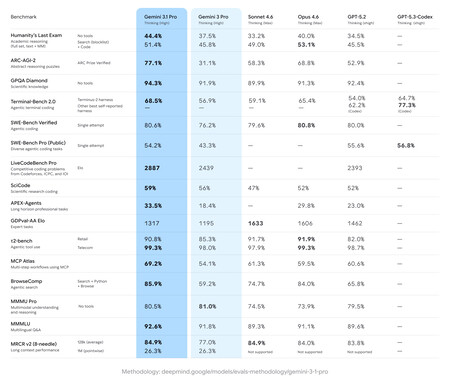
The performance of Gemini 3.1 Pro on the ARC-AGI-2 benchmark, designed to evaluate the ability to discern new logical patterns, achieved a remarkable 77.1% accuracy. For context, Gemini 3 Pro previously scored only 31.1%, while competing models like Claude Sonnet 4.6 and Opus 4.6 scored 58.3% and 68.8%, respectively. This leap illustrates Google not only closing the gap but surpassing it altogether. Notably, this improvement marks an unprecedented advance in reasoning capabilities during a mid-term review.
Performance Across Other Benchmarks
In various other benchmarks:
- Humanity’s Last Exam: 44.4% accuracy (leading)
- GPQA Diamond: 94.3% in scientific knowledge (top performer)
- APEX-Agents: Doubled the performance of its predecessor
- Other areas of excellence include MCP Atlas (multi-step workflows) and BrowseComp (agent search).
Despite these achievements, Gemini 3.1 Pro did fall short in some specific tests, highlighting that no model is perfect. For instance, Claude Sonnet 4.6 outperformed it in real-world task evaluations, and Opus 4.6 had a slight edge in programming accuracy.
Google’s Competitive Edge
What sets Google apart is not solely the capabilities of its latest model. The company’s AI is integrated into various daily-use applications such as Search, Gmail, YouTube, and more, effortlessly blending into users’ routines. While startups like OpenAI and Anthropic must entice users to their specific environments, Google has already established a vast user base across its platforms. This integral presence creates a protective moat that rivals may struggle to breach.
Pricing and Accessibility
Gemini 3.1 Pro is accessible through Google AI Plus, Pro, and Ultra subscriptions. Limited trials are available on a free plan, with the current model being in its preliminary version. Google effectively communicates that for a modest price, users gain access to advanced AI alongside its comprehensive ecosystem, making it hard for competitors to match.
Conclusion: The Future of AI with Google
The AI race has accelerated significantly, and Google, once a latecomer, is now a formidable competitor. The leap from Gemini 3 to 3.1 in reasoning is more substantial than many rivals have achieved in full version updates. As Google navigates the monetization of its AI technologies, it’s clear they’ve streamlined their strategies.
With the integration of AI into essential entry points on the Internet, Google remains a powerful force in this rapidly evolving landscape.