

I fondly remember that time when Intel and AMD were locked in a battle to create the first CPU capable of reaching a 1 GHz clock frequency. AMD emerged victorious in that race, but before this milestone, the pace of technological advancement seemed dizzying. Fast forward to today, and the pace of AI launches is absolutely chaotic, especially over the last few weeks.
What a few weeks we’ve had, dear readers! Here’s a quick recap of the recent AI launches:
- January 27: Kimi.ai launched Kimi J2.5
- February 5: Anthropic released Claude Opus 4.6
- February 5: OpenAI launched GPT-5.3-Codex
- February 5: Kuaishou released Kling 3.0
- February 12: Z.ai launched GLM-5
- February 12: ByteDance released Seedance 2.0
- February 12: MiniMax launched MiniMax 2.5
- February 16: Alibaba released Qwen3.5-397B-A17B
- Coming soon: DeepSeek v4, Does it call?, Gemini 3.1, and more!
This feverish pace is almost overwhelming. The language models that seemed groundbreaking just weeks ago now feel outdated as the new versions rush in. This rapid evolution of AI technologies has each company striving to outdo the last, leading to innovations happening at an almost dizzying rate.
However, this race has its ups and downs. As we wrap up 2025, there’s a sense of boredom surrounding AI innovations that promised much but delivered little. It wasn’t until the end of the year that significant breakthroughs, like the impressive combination of Claude Code and Opus 4.5, caught our attention.
The success of the Anthropic duo can’t be overstated; developers are increasingly able to make demands on the AI, receiving quick and accurate responses. This newfound autonomy and versatility, exemplified by Claude Code and Opus 4.5, signals a pivotal shift in how we interact with AI.
Recent launches like OpenClaw have also raised expectations for AI agents. Alongside these, the market has seen a surge in generative AI models in various domains, such as video (Kling 3.0 and Seedance 2.0). With each new model, there’s a promise of exceeding the performance benchmarks set by its predecessors.
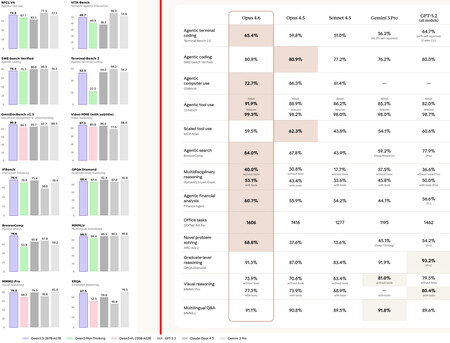
Benchmark comparisons: Left – Alibaba’s Qwen3.5. Right – Anthropic’s Opus 4.6.
The accompanying graphs have become a regular feature, especially with releases from Chinese companies, while Western developers prefer tables to present their findings. The outcome remains consistent: each new model seems to outperform previous versions and often outshines various competitors.
AI Subscription Fatigue
The relentless competition creates a unique challenge for users. A model that appears fantastic today may fall behind tomorrow, either due to a marginal improvement from a competitor or through cost advantages typically seen in Chinese models. Furthermore, these newer models often offer extended context windows, allowing for larger inputs, such as code repositories.
This leads to a dilemma for users. Signing up for Opus 4.5 might seem wise, but committing long-term could limit one’s ability to explore other promising models. Short-term subscriptions could provide a solution, enabling users to evaluate multiple models monthly without extensive commitment.
However, the high cost of subscriptions—around €20 for a month—makes trying multiple models a financial strain. Even though cheaper Chinese models may lag slightly in capability, they pose a compelling choice for budget-conscious users.
Yet the question remains: If I subscribe to the seemingly excellent GPT-5.3-Codex, how long do I lock myself in? Should I try GLM-5, Opus 4.6, and MiniMax 2.5 consecutively, or stick with one for a longer term? Resolving these dilemmas is tricky.

Each user has individual needs and preferences, so even with benchmarks available, the perception of AI models resembles wine tasting: subjective and personal. Consequently, this rapid development heightens expectations, with users eagerly anticipating genuine breakthroughs in functionality.
Though not flawless, solutions like vibe coding present significant improvements, while AI agents like OpenClaw hint at a future where AI functions as a 24/7 assistant—albeit imperfect at first, it feels closer than ever to reality.
These are indeed dizzying and fascinating times for AI.
Image | Mohammad Rahmani
In Xataka | China’s humanoid robots recently showcased kung-fu skills on national TV with extraordinary precision.