
The Fascinating Reproductive Strategies of Spanish Ants
Nature showcases a staggering variety of reproductive methods. From simple clonality to intricate sexual reproduction systems involving the generation of multiple sexes and morphs, the diversity is astonishing. Yet, a groundbreaking discovery has emerged from the world of ants, particularly those hailing from Spain.
Breaking the Boundaries of Species
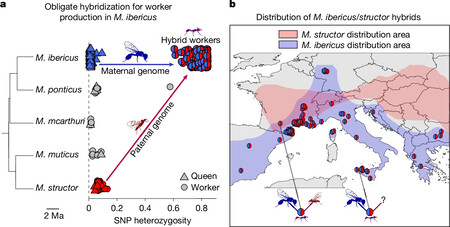
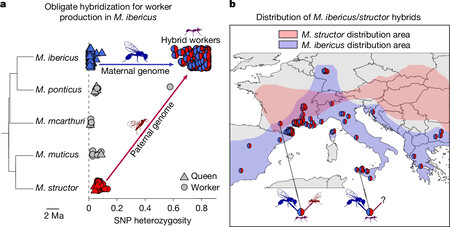
In a surprising twist, researchers have found that the Spanish ants, specifically the queens of Messor ibericus, are defying the traditional boundaries of species. After analyzing over 120 populations and nearly 400 individual ants, experts from the University of Montpellier concluded that these queens are cloning males from Messor structor. This clever manipulation results in the creation of hybrid workers, which are vital for expanding their colonies across Europe.
While these hybrid workers serve as the labor force for the anthill, it’s essential to clarify that this isn’t a system akin to human slavery. Instead, it represents a fascinating evolution of reproductive strategy.
Juvé et al. (2025)
Understanding the Mechanism
Social insect colonies function similarly to factories; without adequate workers, there can be no home, sustenance, or the possibility of reproduction. Researchers suggest that the queens of Messor ibericus require the genetic traits of other species to produce viable workers. Thus, these ants pursue an unorthodox method of reproduction to ensure their survival and proliferation.

Importance of the Discovery
This discovery is pivotal for numerous reasons. Primarily, it challenges the established understanding of what constitutes a species and prompts a reevaluation of sexual reproduction. It highlights the notion of colonies as ‘superorganisms,’ revealing greater complexity than previously imagined.
Sexual Domestication: A New Concept?
Can we truly refer to this phenomenon as sexual domestication? While the term may serve as a metaphor for this intricate process, the emergence of colonies utilizing reproductive ‘livestock’ indeed alters the scientific landscape. Moreover, it illustrates how effectively these ants are adapting and expanding throughout Europe.
The Challenge Ahead
Despite the success of the Spanish ants, it’s essential to note that they are not the only species vying for dominance. The continent is witnessing an invasion of other ant species, including the notorious Argentine and red fire ants. This biological invasion is closely linked to globalization and represents a significant challenge for ant colonies across Europe.
By becoming less reliant on M. structor, M. ibericus can explore new territories more freely. However, they find themselves in an ongoing battle against invasive fire ants—a conflict that may still be unfolding.
Image Credit: Phil Honle
In conclusion, the story of the Spanish ants serves as a fascinating chapter in the broader narrative of evolution and adaptation in the natural world.