
In the 80s, when we enjoyed films like ‘Indiana Jones’, the quality of video was a mystery wrapped in shadows. The VHS tapes portrayed scenes so hazy that the minutiae of life, like a character’s four-day beard, went unnoticed. For those of us who grew up during this era, the importance of image resolution felt abstract and almost magical.
When I played ‘Match Day II’ on my C64 with its 320×200 pixel screen, I didn’t think much about visual fidelity. I was content with the fun and the competitive spirit I shared with my brother, regardless of the pixelated landscape of the game. However, as technology advanced, our perspective on resolution changed significantly.
From VHS to Full HD
The shift began with DVDs, which boasted a resolution of 720×576 in the PAL system. Suddenly, watching ‘The Goonies’ or ‘Indiana Jones’ became an experience that revealed far more detail, including Harrison Ford’s stubble. The introduction of HD Ready (720p) and Full HD (1080p) brought about a notable transformation in viewing experiences, allowing us to appreciate finer details in scenes previously obscured.
This revolution in resolution was so impactful that Full HD quickly became the industry standard, though it would soon be overshadowed by the emergence of 4K resolution. With better clarity, viewers were now able to see every detail, and indeed, perhaps too much detail. Harrison Ford’s pores were now visible, elevating the excitement—and perhaps even discomfort—of movie watching.
The Rise and Fall of 8K Resolution
With the mantra of “more is better,” manufacturers pushed the envelope further with 8K resolution. The theory was that this new standard would offer an exhilarating leap in image quality. However, the reality proved to be quite different. Research indicated that the visible improvements in quality were inconsistent and unremarkable, leading many to question the practical value of 8K technology.
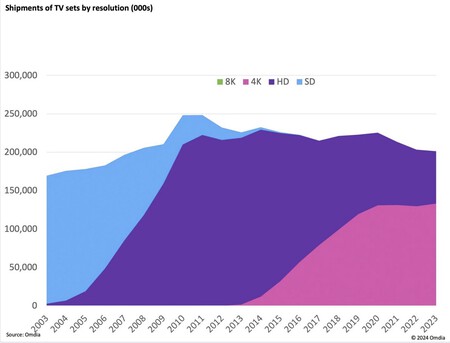
The market for 8K television is largely unprofitable. Source: Omdia.
Key players in the industry are starting to retreat from the 8K market. TCL and LG have largely abandoned their commitments to 8K, while Samsung continues to offer products but with declining support from competitors like Sony. Sales have plateaued, with only 1.6 million 8K TVs sold since their introduction in 2015, dwarfed by the nearly 1 billion 4K TVs in use today.
Challenges and Limitations
The gaming industry, which many believed could benefit from 8K, hasn’t embraced it either. With advancements in graphics technology, running games at 8K and 60fps remains a distant dream for most users. The PS5 performs admirably at 4K, making the prospect of 8K nearly implausible.
Streaming services are grappling with their challenges as well. While obtaining 4K content is still tricky for many, the idea of streaming 8K is laden with technical difficulties, which further reduce the incentive for consumers to upgrade.
The Future of Viewing Experience
Research from the University of Cambridge even reveals a startling fact: the difference between 4K and 8K becomes noticeable only when viewing a 50-inch screen from about a meter away. This realization makes the market’s enthusiasm for 8K even more puzzling.
As of now, the interests around 8K resolution seem to have waned. Despite the potential advancements in technology, consumer demand appears stagnant. Perhaps, like Harrison Ford, we may not care as much about razor-sharp details on screen; instead, we value the stories told through them.