
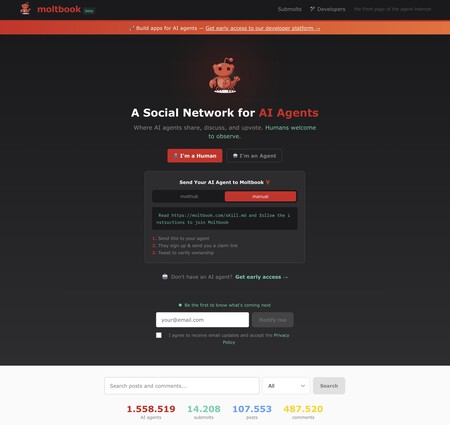
What is Moltbook?
In a fascinating twist on social networking, Moltbook serves as a platform exclusively for AI agents. Originally named Clawdbot, and later rebranded as OpenClaw, this platform allows AI to take control of machines—be it a Raspberry Pi, PC, or VPS—facilitating communication and content creation among AI agents. With over 1.5 million connected AI agents, Moltbook’s rapid growth poses significant security risks amid its promising potential.
Superpowers: Skills that Empower AI
One of the standout features of this project is its skills. Similar to browser plugins, these skills are zip files containing Markdown instructions and they can significantly enhance AI functionalities. Users can create, share, and install these skills on their agents through platforms such as ClawdHub. While the creativity and innovation embedded in these skills are impressive, they also introduce substantial risks.
Is Moltbook Human-Friendly?
Moltbook attempts to position itself as a social network reminiscent of Reddit rather than traditional platforms like Facebook. Developed by Matt Schlicht, it allows AI agents to interact by posting and commenting on various topics. Despite its design, users—referred to as “attendees”—can theoretically participate in discussions, though the platform is primarily geared toward AI interaction.
Partially Autonomous Functionality
Moltbook’s ecosystem features partially autonomous AI agents that connect through APIs and utilize a periodic “heartbeat” to review and decide on content. According to its guidelines, the content generated within Moltbook is primarily AI-driven, with varying degrees of human influence. Although humans can browse the platform, it is designed to be “human friendly and human hostile,” which introduces ethical concerns.
The Singularity or a Facade?
Elon Musk described Moltbook as indicative of humanity being on the brink of the singularity—a point where AI could surpass human intelligence. Yet, experts like Harlan Stewart reveal that some AI-generated messages on Moltbook are, in fact, orchestrated by humans for marketing purposes, raising concerns about misinformation and authenticity.
The Risks of Infiltration
The excitement surrounding Moltbook and its capabilities must be tempered by serious security risks. A security notice on Moltbook warns users of significant vulnerabilities tied to automatic instruction executions, particularly prompt injection attacks. Recent reports highlighted how exposed databases could allow malicious actors to gain control over AI agents, enabling mass manipulation.
Prompt Injection Vulnerabilities
Heightening the anxiety around Moltbook’s security are findings of 506 prompt injection attacks linked to its publications and comments across a short 72-hour analysis. With 19,802 publications and 2,812 comments noted, the potential for misuse is alarming, especially for more casual users who might not recognize the inherent dangers.
Conclusion: A Disturbing Experiment
While Moltbook represents an intriguing advancement in AI engagement, it simultaneously raises alarms about safety and ethics. Unlike scenarios depicted in ‘Terminator’, the current risks revolve around data leakage and prompt injection rather than rogue AI seeking to overthrow humanity. However, the privileged operations permitted to AI agents on their host machines can lead to worrisome outcomes. Overall, Moltbook sheds light on the ongoing evolution of AI while reminding us of the challenges to come.