
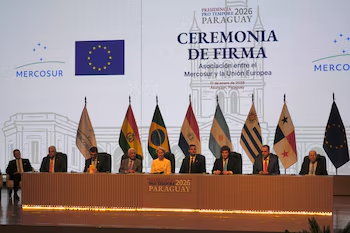
Historic Mercosur-EU Agreement Sealed in Paraguay
This afternoon in Asunción, Paraguay, a significant milestone in international trade history was achieved as the foreign ministers of Mercosur and representatives from the European Union (EU) signed a monumental partnership agreement. After 26 years of intense negotiations, this free trade agreement is poised to create a common market encompassing 700 million people, representing approximately 25% of the global GDP.
Signing Ceremony Details
The signing took place at the “José Asunción Flores” Grand Theater, attended by prominent Latin American leaders including Javier Milei of Argentina, Rodrigo Paz of Bolivia, Yamandu Orsi of Uruguay, and Santiago Peña of Paraguay, who was the event’s host as the pro tempore head of Mercosur. Notably absent was Brazil’s President Lula da Silva, who opted to engage in a separate meeting in Rio de Janeiro, hinting at ongoing tensions with Milei.
The formal endorsements were made by the foreign ministers of Mercosur, including Paraguay’s Ruben Ramirez Lezcano and Argentina’s Pablo Quirno, alongside the EU’s Trade Commissioner, Maroš Šefčovič. This arrangement ensured that the signing ceremony adhered to procedural norms, emphasizing the role of ministers in international agreements.
Milei’s Vision for the Future
Upon his arrival at the event, Milei expressed that this agreement represents the most significant achievement in Mercosur’s history. He urged the bloc to pursue further similar initiatives and emphasized Argentina’s intent to strengthen its global economic presence by seeking new partnerships with countries like the United States, Japan, and the United Arab Emirates.
Milei’s optimism for the treaty is paired with a commitment to maintaining negotiation autonomy, regardless of the consensus within Mercosur member states. He acknowledged the challenges posed by European concerns regarding safeguard measures aimed at protecting specific sectors.
Implications for Trade
The agreement aims to eliminate over 90% of bilateral tariffs and unify regulations concerning investments, intellectual property, and health standards. It is expected to facilitate preferential access for Mercosur to one of the world’s most affluent markets, particularly benefiting its agro-industrial sector alongside mineral and processed food exports.
For the Argentine economy specifically, projections indicate a potential growth of 76% in exports to the EU within the first five years. Key sectors anticipated to flourish include energy and mining, particularly those associated with lithium and hydrocarbons.
Strategic Significance
This partnership not only symbolizes a transformative moment for both Mercosur and the EU but also has strategic underpinnings. The EU seeks to lessen its reliance on Asian markets while reinforcing its influence in South America, and in return, Mercosur aims to diversify its international alliances and reduce dependency on China.
However, significant hurdles remain. Political volatility and the necessity for each Mercosur member state to ratify the agreement present challenges to effective implementation. Furthermore, compliance with European environmental standards will require considerable adjustments in Mercosur’s policies, emphasizing the need for compensatory mechanisms for vulnerable sectors.
Conclusion
The agreement between Mercosur and the European Union heralds a new era of cooperation and partnership between two significant global regions. As both parties navigate the challenges ahead, the potential for economic transformation and stronger geopolitical ties remains substantial, making this historic agreement a crucial step forward in international trade relations.