
## Unveiling the Lost City of Issyk-Kul: Toru-Aygyr
If there’s one myth that has captivated historians and archaeologists for centuries, it’s the search for Atlantis. While many submerged cities have been uncovered, such as Thonis-Heracleion in Egypt and Pavlopetri in Greece, a fresh discovery in the northwestern waters of Lake Issyk-Kul, Kyrgyzstan, has emerged as a significant site—Toru-Aygyr.
### The Discovery
In a groundbreaking expedition led by the Russian Geographical Society and the Institute of Archeology of the Russian Academy of Sciences, underwater drones uncovered the remains of Toru-Aygyr. This site dates back to the 13th and 14th centuries and boasts remarkable preservation thanks to the lake’s conditions.
### Legends Come to Life
Local folklore has long suggested that a grand city lies beneath the tranquil surface of Lake Issyk-Kul, with stories of its existence passing through generations. Historical documents, including those from the Catalan Atlas by the cartographer Cresques Abraham, hinted at the presence of significant structures, including a monastery purported to house the remains of San Mateo.
#### Unique Attributes of Lake Issyk-Kul
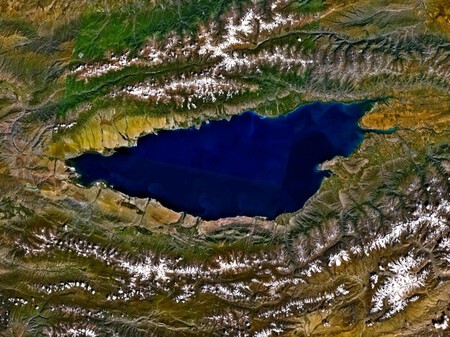
Known as the “hot lake,” Issyk-Kul holds the title of the second-largest alpine lake in the world, after Titicaca. Situated at an elevation of 1,609 meters, it is characterized by its geothermal activity, slight salinity, and remarkable transparency, allowing for visibility up to 20 meters deep.
### The City’s Architecture
Toru-Aygyr is unique among submerged cities due to its ruins being in relatively shallow waters, possessing remarkably intact stone structures, clay bricks, and even wooden beams. This indicates an advanced urban infrastructure, featuring public buildings, homes, and irrigation systems.
The archaeological team discovered a medieval cemetery, large ceramic vessels, and remains that suggest the city was an essential hub for silk, spices, and metals along the Silk Road from the 2nd century BC to the 15th century.
### The Silk Road Connection
As researchers affirm, Toru-Aygyr played a crucial role in the exchange of goods between China and the Mediterranean. The city is viewed as the missing link of the Silk Road, with historical sources highlighting its significance as a commercial center.
### Catastrophic End
Like the ancient city of Pompeii, Toru-Aygyr’s end came abruptly. Earthquakes in the early 15th century are believed to have led to its submergence under the lake. According to researcher Valery Kolchenko, the settlement may have already been abandoned prior to the disaster, resulting in a haunting parallel to Pompeii—though less known to modern audiences.
### Reflections on the Discovery
Though Toru-Aygyr cannot be labeled Atlantis, its discovery resonates with the same allure, weaving together myths, historical records, and invaluable archaeological findings. It stands as a testament to a once-prosperous urban civilization that vanished beneath Lake Issyk-Kul’s waters.
### Conclusion
Toru-Aygyr’s archaeological significance highlights the city’s historical importance as a trade nexus and provides a fascinating glimpse into a forgotten era. As research continues, this submerged site offers an extraordinary opportunity to connect with the profound legacy of the Silk Road and the stories hidden beneath the waters.