
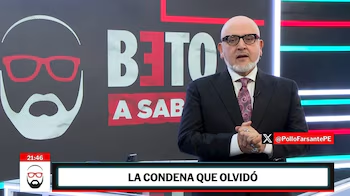
Beto Ortiz Questions Carlos Álvarez: A Call for Transparency in Politics
The recent exchange between journalist Beto Ortiz and candidate Carlos Álvarez has sparked a heated discussion in the political landscape. Ortiz’s probing questions focused on Álvarez’s omission of a significant judicial history in his resume submitted to the National Elections Jury (JNE), particularly relating to payments he allegedly received from Vladimiro Montesinos during the Alberto Fujimori regime.
The Core of the Controversy
During a widely viewed segment, Ortiz highlighted that Álvarez had not declared a judicial sentence concerning payments linked to Montesinos, known for his role in corrupt activities during the 1990s. Ortiz bluntly reminded viewers of Álvarez’s past, mentioning that while in charge of a comedy show on Channel 7, he reportedly received monthly sums from Montesinos’s circle. According to Ortiz, official records substantiate that these payments were not mere rumors but rather investigated thoroughly by anti-corruption courts.
Judicial Findings and Allegations
Ortiz emphasized that while Álvarez claims to have been acquitted by the Supreme Court, no formal record of such acquittal exists. Instead, official documents reflect a conviction for accepting money from Montesinos, which places Álvarez’s transparency into question. The Third Special Criminal Chamber of the Superior Court of Justice of Lima sentenced him to four years, later modified to three years of suspended imprisonment, but crucially, it was never annulled.
Electoral Accountability and Ethical Standards
The context deepens with the omission of the conviction on Álvarez’s resume presented to the JNE. In the section querying past sentences, he misleadingly answered “No.” This oversight, per Ortiz, constitutes a serious offense that could potentially lead to exclusion from the electoral race. The integrity of information submitted to the JNE is paramount to ensuring clean and fair elections.
Additional Inconsistencies and Questions Raised
Further scrutiny revealed inconsistencies in Álvarez’s asset declaration, notably his failure to declare a Mazda CX-90 valued at 160 thousand soles, while only mentioning a 2013 Porsche. Such selective reporting raises alarms regarding the candidate’s honesty and ethical standards.
The Political Climate of the 1990s
Ortiz contextualized the payments as part of a collaborative effort during Fujimori’s re-election campaign, highlighting the political climate of the 1990s marked by media manipulation and suppression of dissenting voices. The environment underscores the importance of accountability for those seeking positions of power.
Conclusion: The Need for Transparency
Beto Ortiz concluded with an emphatic reminder that entering politics requires transparency and an openness to scrutiny. He voiced strong skepticism about Álvarez’s evasive response to legitimate concerns about his judicial past, stating, “If you don’t want to face uncomfortable questions, don’t enter politics.” This call for honesty as a foundation of the electoral process resonates with many constituents who expect their representatives to uphold the highest ethical standards.
In closing, the questioning of Carlos Álvarez serves not only as a personal critique but as a broader indictment of the need for integrity in politics, reinforcing the idea that elected officials must be held accountable for their past actions.