
The Rapid Growth of Satellite Infrastructure
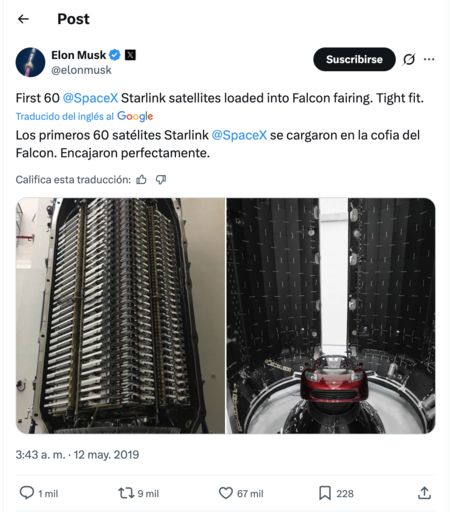
Rarely has a technological infrastructure grown so quickly and out of the everyday radar. While for almost everyone the sky remains as usual, thousands of Starlink satellites are already moving in low Earth orbit, building a network designed to bring connection to almost any point on the planet. In just a few years, SpaceX has evolved from its first experimental launch to become the world’s largest satellite operator. This buildup of hardware in space presents opportunities, but also annoyances for parts of the scientific sector.
FCC’s Green Light for Expansion
The most recent movement comes amid criticism from the astronomical community about the impact of these satellite constellations on sky observation. The Federal Communications Commission (FCC) authorized SpaceX to deploy another 7,500 second-generation Starlink satellites, bringing the total authorized Gen2 satellites to 15,000. The FCC not only greenlit this expansion but also allowed for technical improvements and a more flexible use of frequencies and coverage, facilitating advanced mobile services and connections of up to 1 gigabit per second.
Details of the Authorization
The FCC has given SpaceX room to redesign and optimize its satellite constellation. This permit includes updates to the second-generation Starlink satellites with new form factors and advanced technology. It allows for the joint use of various frequency bands—Ku, Ka, V, E, and W. Furthermore, the elimination of limits that previously blocked beam overlap and the creation of new orbital layers between 340 and 485 kilometers presents a way to optimize coverage and performance.
Limitations and Future Challenges
However, the permit does not cover everything SpaceX had requested. The company initially sought authorization to deploy nearly 30,000 second-generation satellites, but the FCC decided to authorize only half for now. One reason for this caution is that part of the Starlink Gen2 satellites has yet to be tested in orbit, and uncertainties remain about operations at higher altitudes above 600 kilometers.
Timeline and Deployment Expectations
The FCC approval is not indefinite. SpaceX must demonstrate tangible advances in the coming years. At least half of the authorized constellation must be operational in their assigned orbits by December 1, 2028, with the remainder before December 2031. Additionally, the FCC mandates that the deployment of the first generation should conclude before November 2027, as the company prepares for a reconfiguration for 2026 that will lower thousands of satellites to a reduced orbit to minimize risks.
Enhancing Global Connectivity
Expansion is not solely about increasing bandwidth. A segment of the constellation aims to enable direct mobile connectivity in regions outside the United States, also strengthening coverage within the country. This approach facilitates mobile services and data in areas lacking land towers, which aligns with Starlink’s agreements with T-Mobile and other international operators.
Controversies and Concerns
Massive satellite systems have drawn considerable criticism. Astronomers have long warned that constellations like Starlink create trails in optical images and generate “noise” in radio telescopes. This concern has led to the establishment of a specific center by the International Astronomical Union to safeguard the “dark and silent sky.” Additionally, there are apprehensions regarding orbital saturation and the risk of collisions, a topic that has gained renewed attention following recent incidents.
Images | Mark Handley | SpaceX
In conclusion, the rapid deployment of additional Starlink satellites raises both remarkable potential for global connectivity and pressing challenges that must be addressed as we progress into an increasingly satellite-filled sky.