
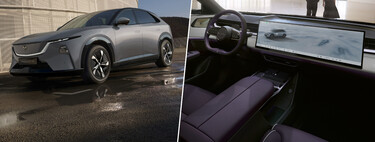
Xpeng’s Revolutionary G7 SUV: A New Era in Extended Range Vehicles
Among new energy vehicles, hybrid, plug-in hybrid, and pure electric models each serve specific needs. However, the lines between these categories are becoming less defined due to evolving technologies. Enter the Extended Range Electric Vehicle (EREV) category, which offers unique advantages. China, a leader in promoting these vehicles, has seen Xpeng Motors push the boundaries of what is possible.
The G7 SUV Breaks Records
Xpeng recently unveiled a hybrid version of its G7 SUV, capable of an astonishing 1,704 kilometers of combined range. This achievement sets a new world record for EREV models, as announced during a presentation in Guangzhou. For context, this distance is roughly equivalent to the journey between Madrid and Milan without the need for refueling or recharging.
The Secret Behind the Record
The G7’s impressive range stems from a sophisticated design that combines a 55.8 kWh battery with a 1.5-liter combustion engine, which solely acts as a generator. This hybrid system facilitates a fully electric range of 430 kilometers, powered by a 60-liter gasoline tank that provides additional energy. Under the Chinese CLTC homologation cycle, the G7 surpasses all other SUVs currently on the market.
Advancements in Technology
Xpeng’s shift from a purely electric strategy to a dual powertrain approach addresses growing concerns regarding charging infrastructure, which remains insufficient in many regions. This dual strategy also applies to the P7+ sedan, which boasts a combined range of 1,550 kilometers. Xpeng President and CEO He Xiaopeng emphasized that the P7+ now offers the longest pure electric range in its class.
State-of-the-Art Features
The updated G7 SUV is brimming with advanced features, including:
- 800V voltage system with ultra-fast 5C charging
- A 15.6-inch touchscreen
- A 2.17-square-meter panoramic roof
- A premium 20-speaker sound system
Moreover, the vehicle is equipped with power-adjustable seats featuring ventilation, heating, and massage options to enhance passenger comfort.
Autonomous Driving Capabilities
In terms of autonomous driving, the G7 comes standard with two Nvidia Drive Orin chips, offering 508 TOPS of computing power. For those seeking enhanced capabilities, an optional Ultra SE system incorporates two proprietary Turing AI chips, while a more advanced Ultra system includes three chips.
International Growth Plans
Xpeng’s commitment to EREV technology aligns with its ambitions for international expansion across Europe, Southeast Asia, the Middle East, and Africa. By 2025, the company aims to operate in 60 global markets and double its exports, targeting the sale of more than 45,000 units. Notably, Xpeng has established three production facilities outside China: in Indonesia, Austria, and Malaysia.
Market Viability
For regions like Europe, where the charging infrastructure is still developing, EREV models like the G7 offer a practical solution to address emissions regulations and driving range challenges.
Pricing Strategy
Xpeng’s G7 and P7+ models remain competitively priced, with starting figures of 195,800 yuan (approx. €26,000) for the G7 and 186,800 yuan (approx. €25,000) for the P7+.
Future Innovations
Beyond automobiles, Xpeng took the opportunity to introduce its second-generation VLA 2.0 (Vision Language Action) AI model, which integrates visual perception and language understanding. Slated for launch in March 2026, this system aims to bring vehicles closer to level 4 autonomy.
Xpeng is also actively working on robotaxis equipped with this innovative AI, which are undergoing trials on public roads after passing third-party tests.
Conclusion
With its G7 SUV, Xpeng Motors not only sets a new benchmark for extended range vehicles but also paves the way for future advancements in hybrid technology and autonomous driving. As the market looks toward greener alternatives, innovations like these will be pivotal in shaping the automotive industry.