
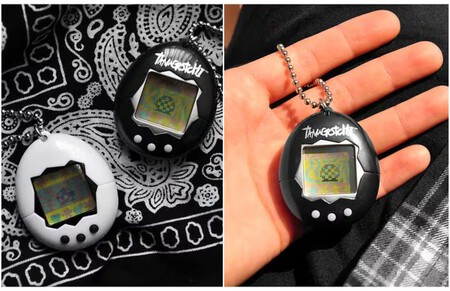
Thirty years after its debut in Japan, the Tamagotchi remains an icon, instantly recognizable by its egg shape, three buttons, and a minimal screen displaying animated pixels reminiscent of the nineties. Yet, this nostalgic toy has evolved, with Bandai continuously updating its versions to appeal not just to childhood fans but to new generations yet to experience its original charm.
This evolution from a phenomenon to a lasting cultural symbol results from more than just nostalgia. The Tamagotchi fostered a new type of relationship with devices— it required constant care, feeding, and maintenance. Crucially, there was no pause button, and neglecting your Tamagotchi led to consequences. This concept predates the modern “attention economy,” establishing a foundation for our current digital interactions.
A Japanese Toy that Taught Digital Coexistence
Functionally, the Tamagotchi is a simple simulation of care contained in a portable device. It has a series of rules dictating the health and happiness of its digital pet, which users can influence through repetitive interactions. However, there’s no intricate learning curve or defined endpoint. The essence lies not in winning but in nurturing a bond.
The game’s focus shifts from control to coexistence; it encourages ongoing engagement rather than isolated play sessions. This distinction allowed the Tamagotchi to transcend conventional toy categories and merge into everyday life, requiring attention at unpredictable times throughout the day.
The launch of the Tamagotchi in 1996 can be better understood within its industrial context. At a time when Bandai sought to connect with young audiences already immersed in technology, Japan’s culture was also adapting to portable, personal devices. This rich backdrop enhanced the Tamagotchi’s marketability and acceptance.
A significant aspect is that the Tamagotchi did not rely on pre-established franchises. Instead, its genius was in its simplicity, portability, and visual language— characteristics resonating with Japanese aesthetics of that era. This made it not just a toy but a personal item that could be shared and talked about openly.
Although often attributed to a singular visionary, the Tamagotchi’s origin story reflects a collaboration between Akihiro Yokoi, the initial concept creator, and Aki Maita from Bandai, who turned that concept into a commercial product. This dual authorship enriches the narrative, illustrating how collective effort often leads to cultural milestones.
Prior to its launch, Bandai conducted user testing, an atypical move in the toy industry at the time. These tests unearthed a strong interest among teenagers, particularly girls, heavily influencing the product’s aesthetic and its social presence.
The name “Tamagotchi” cleverly blends the Japanese word tamago (egg) and wach (related to frequent interaction). This reinforces the understanding that it was not just an occasional toy but an item meant to be carried and checked regularly.
The original Tamagotchi design did not allow users to freeze the device or absolve themselves of neglect’s consequences, heightening the emotional stakes of abandonment. Bandai designed it to demand consistent care, making its users feel a relatable sense of responsibility.
When the Tamagotchi achieved international fame in the late 1990s, it faced unexpected challenges. Its arrival in the United States and subsequent spread globally stirred supply issues and created a complex social dynamic. Instead of being seen as just a toy, it became a cultural phenomenon, appearing in classrooms and sparking conversations far beyond its intended context.
As time went by, Bandai continued to innovate without altering the core concept. By introducing features like infrared connectivity to allow interaction between devices, they kept the Tamagotchi relevant. This cycle of gradual adaptation rather than abrupt transformation meant it could engage new generations while retaining its essential identity.
Today, thirty years later, the Tamagotchi’s resurgence is fueled by nostalgia among adults while appealing to younger audiences. Unlike modern virtual pets packed with AI features, it maintains straightforward mechanics. This positioning preserves the unique qualities that differentiate it in today’s gadget-saturated environment, emphasizing simplicity and predictability over overwhelming complexity.
The Tamagotchi’s enduring appeal stems from its ability to blend tangible experiences with digital interaction, providing a refreshing antidote in an era dominated by high-tech solutions. Its legacy teaches us not just about caring for virtual pets but about how to build meaningful relationships with technology.
Images | Antonio Rubio | BANDAI