
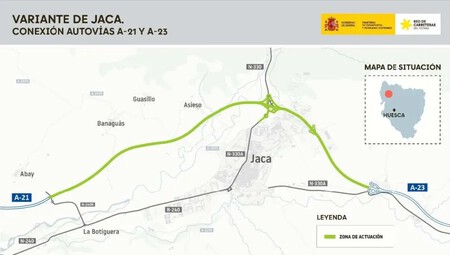
The Ministry of Transport has tendered for €153.6 million the Jaca Bypass, addressing the last significant political and technical challenge to the highway linking Pamplona to Catalonia. After years of local opposition, this project is set to complete Aragón’s alternative route to the Ebro via the Pyrenees.
Why It Matters
For decades, the Jaca variant has posed the most intricate link within this road infrastructure. A significant portion of the municipality resisted the project, citing concerns over construction noise and related inconveniences. The recent tender announcement signals the removal of both legal and social barriers, paving the way for construction to begin.
Project Overview
The bypass involves an 8-kilometer stretch designed to divert medium and long-distance traffic from the congested N-330a and N-240 highways through Jaca. This new pathway will connect the A-21 (Pyrenees Highway) with the A-23 (Mudéjar Highway), facilitating smoother travel as speed limits currently restrict traffic flow through the city’s center to 50 km/h.
Image: Ministry of Transport
Detailed Project Features
The project entails designing two roads, each featuring two lanes with a median of varying width. Key components include three interchanges (Jaca East, North, and West), three viaducts, five overpasses, and a 200-meter false tunnel near the hospital area. According to the Ministry of Transport, environmental considerations will also be part of the project, such as revegetation, measures to mitigate wildlife access, and noise pollution control.
Completing the Pyrenean Corridor
With the Jaca variant now tendered, Aragón is on the verge of completing its Pyrenean corridor. In the coming months, an additional 8.7 kilometers connecting Sabiñánigo Este to Sabiñánigo Oeste will be inaugurated. By 2026, another 11 kilometers will be opened between Lanave and Sabiñánigo, leaving approximately 12 kilometers still to be constructed between Puente de la Reina in Jaca and the A-21 in Navarra. Project planning for this last section has been awarded; however, construction is not expected to begin until 2030.
Strategic Importance
The completion of this corridor, comprising the A-21, A-23, and A-22 (Huesca-Lleida), will serve as a vital alternative to the Ebro corridor, which often experiences congestion between Navarra, Aragón, and Catalonia. This initiative aims to enhance the territorial structure of Aragón and reduce traffic stress during peak periods, such as ski season and long holiday weekends, when significant delays often occur.
Future Directions
The execution timeline for the Jaca variant will hinge on the awarding process and construction pace. Nevertheless, the recent tender announcement offers optimism for those advocating for this crucial connection. Once this section and other pending segments in the Sabiñánigo area are finalized, the Aragonese Pyrenean project will be realized, with only the link to Navarra pending completion.
Cover image | Ministry of Transport
In Xataka | This interactive map prepares you for your next flight: it shows if there will be turbulence and how intense it will be before takeoff.