
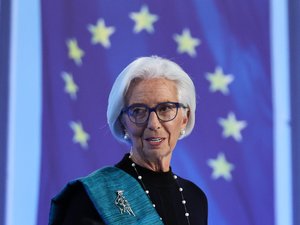
The Exorbitant Salary of Christine Lagarde: The Highest Paid Civil Servant in the EU
According to an analysis by the Financial Times, Christine Lagarde, the President of the European Central Bank (ECB), boasts an annual remuneration that significantly exceeds her official declaration. While the ECB publicly states her salary at €466,000, reports suggest she could actually earn around €726,000, which is a staggering 56% increase over her declared figure.
Understanding Lagarde’s Compensation Package
Christine Lagarde has held the position of ECB President since 2019, overseeing critical monetary policies in the Eurozone. However, her benefits package further complicates the picture. Notably, she reportedly receives €135,000 designated for housing and an additional €125,000 for her role on the Board of Directors of the Bank for International Settlements (BIS). This breakdown sheds light on how her total compensation package positions her as the highest-paid civil servant in the European Union.
Impact on Wage Inequality Discourse
The revelations from the Financial Times allow for a broader discussion on wage inequality within the EU. Critics, including German MEP Fabio De Masi, have pointed out that such a staggering salary—especially in times of economic challenges—throws a spotlight on income disparities. De Masi remarked, “The ECB president is the highest paid civil servant in the EU and should be the gold standard for accountability,” emphasizing the need for transparency in high-level salaries.
Comparison with Other EU Leaders
Lagarde’s declared salary of €466,000 is notably 21% higher than that of Ursula von der Leyen, the President of the European Commission. This raises questions about the frameworks used to determine salaries among EU leaders and whether these figures align with the public’s perception of merit and accountability.
Criticism and Call for Accountability
The backlash from various European stakeholders emphasizes a growing demand for increased scrutiny over the compensation of high-ranking officials. The inconsistency in reported salaries versus actual earnings signals a potential need for reforms that enhance transparency. Given that Lagarde is at the helm of the ECB, one would expect her remuneration to reflect similar accountability measures expected from other civil servants.
Conclusion
As the highest paid civil servant in the EU, Christine Lagarde’s salary has stirred significant debate over wage inequality and transparency among government leaders. These discussions not only spotlight individual compensation but also reflect the broader economic realities facing citizens in the Eurozone. With increasing calls for accountability, it is evident that how we value leadership in economic institutions may require revisiting frameworks and policies that govern these salaries.