
The Blurred Lines Between Civilian and Military Vessels
For decades, large freighters have been the most recognizable symbol of globalization, designed to move goods and little else. However, recent images suggest that the boundaries between civilian transport and military capability are fading. Photographs of a modified merchant ship are circulating, showcasing containers that appear ill-suited for consumer goods.
Revealing the Modifications
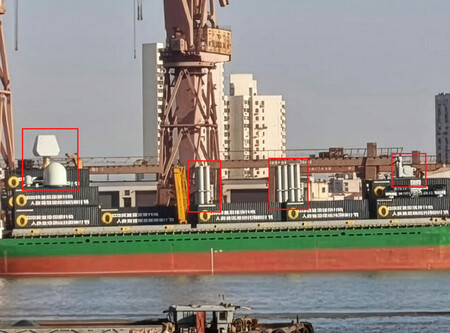
Sources from Weibo—China’s equivalent of X—depict a medium-sized freighter with an unusual configuration. The docked containers and visible equipment do not match standard maritime setups, raising questions about the ship’s purpose. Although there is no official confirmation about the vessel or the timing of the photographs, the analysis relies heavily on observable evidence.
Sensors and Defense Mechanisms
Equipped with innovative technology, the freighter’s deck displays containers repurposed to support advanced equipment. Newsweek highlights several critical elements, including a rotating phased-array radar on the front, mounted on three containers, and a second installation with a dome likely related to communications or other sensors. Additionally, self-defense mechanisms are prominently featured at the bow, particularly a point defense system and decoy launchers, reinforcing the notion that the ship is designed for exposed operational scenarios.
Vertical Launch Systems
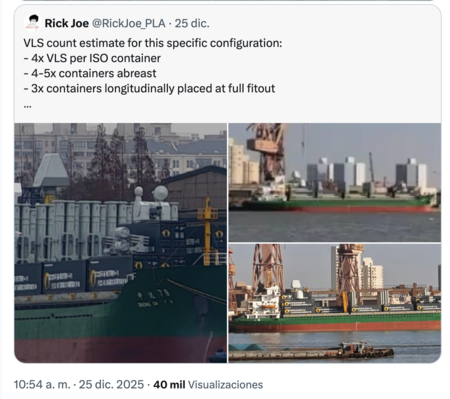
Beyond sensory enhancements, the ship’s most striking feature is the presence of vertical launch systems integrated within the containers. Numerous modules are arranged systematically—five wide by three deep—each equipped with four launch tubes. In theory, this configuration offers a total of 60 vertical cells, signifying a substantial military capacity.
Operational Versatility: Unknown Variables
Despite the visible modifications, the operational capabilities of this configuration remain uncertain. Factors such as mount stability, potential coverage limitations due to the ship’s superstructure, and the lack of data on an integrated combat system create challenges in drawing concrete conclusions. Installing a feature does not equate to effective use in real-world military environments.
The Context of Military Modernization
This development coincides with China’s broader military modernization efforts. The country has introduced various advancements, including the J-20S, a two-seat variant with drone control features, alongside prototypes attributed to the J-36 and J-50 aircraft programs.
Navy Advancements
Furthermore, notable naval enhancements are occurring, such as the commissioning of the Fujian aircraft carrier (Type 003) and the emergence of Type 055 destroyers and new amphibious classes like the Type 076. While the freighter’s modifications may not represent a definitive shift in strategy, they align with the overarching direction of Beijing’s military ambitions.
Concluding Thoughts
The possibilities surrounding this freighter remain largely open-ended, leaving many questions unanswered. Whether this vessel serves as an experimental model or represents a more advanced project, the images underscore a significant consideration: civilian platforms can indeed be adapted for military purposes, concentrating launch capacity while employing their own sensory systems.
Images | Screenshot Weibo and X