
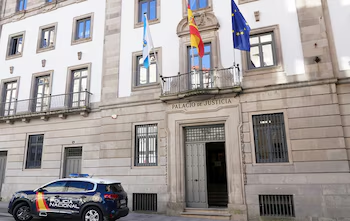
Case Overview: Disinheritance Ruling
The Provincial Court of Pontevedra has officially annulled the clause in the will that sought to disinherit Avelino from his father’s estate. This landmark decision ensures that Avelino will receive the minimum legal inheritance due to him. The case revolved around accusations of “work abuse” and emotional neglect, pivotal concepts under Galician law concerning disinheritance.
Background of the Dispute
The appeal was brought forth by María, the principal heir and sole beneficiary of Elisha’s will, who claimed that Avelino’s emotional damage and distant relationship with his father justified his exclusion from the inheritance. According to María, this lack of a relationship was entirely the son’s responsibility and had caused emotional suffering to Elisha.
Court’s Findings and Conclusions
Both the initial court and the Provincial Court established that María’s claims did not sufficiently justify Avelino’s disinheritance. The relationship, although limited, was not entirely absent. The court noted that while communication was sparse, it could not be categorized as neglect or abandonment.
Avelino, born in 2001, had predominantly lived with his mother in Asturias and adhered to a visitation schedule with Elisha. The court highlighted that a minor cannot be held fully accountable for a lack of interaction with a parent.
Legal Framework for Disinheritance
The legal grounds for disinheriting a child require specific justification outlined in the will, as stipulated in Galician law and the Spanish Civil Code. Mere lack of interaction is insufficient for disinheritance; substantial proof and clear reasoning must accompany such claims.
Clarification of Psychological Abuse
The ruling emphasized that disinheritance could only stem from an ongoing relationship absence directly attributable to the child, classified as psychological abuse. While Elisha’s will expressed distress regarding the relationship, no evidence suggested that Avelino was solely responsible or that his actions amounted to unfair neglect.

Evidence and Relationships Explored
The court reviewed the available evidence, noting the absence of witnesses testifying to personal offenses or failures to adhere to visitation agreements. Conversely, there was proof of some visits and connections, particularly in the final months of Elisha’s life.
The court also examined the principle of “work abuse” and its potential link to psychological harm. It concluded that not every familial dispute warrants disinheritance.
Conclusion and Legal Implications
In summary, the court firmly established that the limited nature of the relationship did not meet the threshold for abandonment. The ruling called for the declaration of nullity concerning Avelino’s disinheritance, with an order for payment of the legal interest in his favor. Additionally, the appellant was required to bear the legal costs of the proceedings.
This decision underscores the Spanish legal system’s commitment to ensuring that familial relationships are respected, particularly in matters of inheritance and disinheritance, preventing unjust exclusions based on unfounded claims.