
The Suspension of the Atlantic Alliance: A Historical Overview
The Birth of NATO
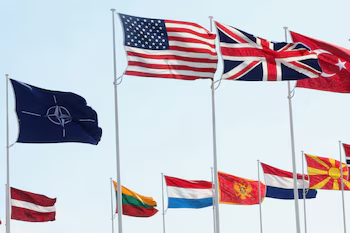
The North Atlantic Treaty Organization (NATO) was established in 1949, emerging as a vital defensive bloc during the Cold War. Initially propelled by the Truman Doctrine, NATO aimed to counter Soviet expansion in Europe. President Harry Truman’s leadership heralded an era of American commitment to rebuilding Western Europe through initiatives like the Marshall Plan, which sought to create a bulwark against the USSR.
The Cold War Dynamics
In 1955, the USSR responded to NATO’s formation by creating the Warsaw Pact, which unified Central European countries under its influence. This intense competition heightened tensions, including missile placements along the Iron Curtain. The end of the Cold War in 1991 saw the dissolution of the Soviet Union and the Warsaw Pact, leading to a significant shift in the geopolitical landscape. Countries formerly under Soviet domination sought membership in NATO, signaling a pivotal victory for the West.
The Evolution of NATO
As Europe integrated economically and politically, NATO expanded further. Countries such as Sweden, Finland, and Switzerland, once considered neutral, began exploring closer ties with the alliance, particularly in response to escalating tensions with Russia. However, political shifts, especially during Donald Trump’s presidency, posed challenges. His administration’s approach often diverged from previous policies, emphasizing a desire to pivot away from longstanding alliances and seek engagement with Russia.
Military Presence in Europe
Currently, the United States maintains approximately 84,000 troops in Europe, concentrated in countries such as Germany, Italy, and the UK, with others in Eastern European nations. Recent discussions about troop withdrawals have raised concerns regarding security commitments in the region.
Cultural and Political Challenges
The ongoing cultural battle within Europe has seen the rise of far-right parties that challenge traditional democratic norms. Trump’s alignment with these parties reflects a broader political trend that threatens to shift the ideological balance away from democratic pluralism. As these movements gain traction, they disrupt the essential fabric of the Western democratic tradition that values political diversity.
Looking to the Future: Restoring the Atlantic Alliance
Going forward, the restoration of a robust Atlantic Alliance is crucial. As tensions grow between major powers like the U.S. and China, nurturing strong ties with key regional players—such as Mercosur, Southeast Asia, Mexico, Canada, Türkiye, and Indonesia—is essential for global stability.
The Path Ahead
We are at a crossroads, navigating a “Chaotic Transition” between the 20th and 21st centuries. Now more than ever, the need for dialogue and balance between East and West is paramount. The future depends on finding common ground to ensure that peace prevails over conflict, and varied ideologies can coexist harmoniously within the framework of a revitalized Atlantic Alliance.