
The Competitive Landscape of AI: OpenAI vs. Google
In the ongoing race for supremacy in artificial intelligence, key developments have unfolded rapidly. On November 12, OpenAI unveiled GPT-5.1, an update designed to enhance user experience. Just days later, Google countered with Gemini 3, which received positive feedback from early users. This competition highlights the urgency for improvements and adaptations in AI technology, as firms like OpenAI feel the pressure from emerging rivals.
Emergence of GPT-5.2: An Immediate Response
Following the debut of Gemini 3, rumors suggested that OpenAI initiated a “code red” to address the competitive threat. This led to the swift rollout of GPT-5.2, which promises to tackle existing challenges while reducing latency and enhancing reasoning capabilities. Unlike its predecessor, GPT-5.2 is positioned as a refinement rather than a complete overhaul, showing a focused approach to knowledge work.
Key Features of GPT-5.2
GPT-5.2 is engineered to improve functionalities in coding, document analysis, and multi-step projects. OpenAI emphasizes that this version enhances long-context management, minimizes errors, and improves tool coordination. The distinctions within its three variants—Thinking, Pro, and Instant—now offer clearer applications based on user needs.
Enhanced User Experience
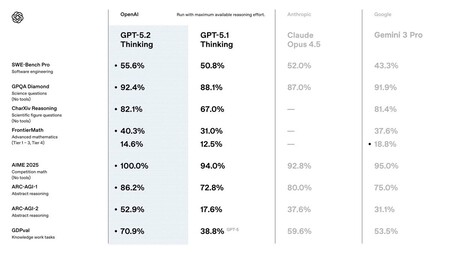
The updated model presents significant improvements across various metrics. For example, GPT-5.2 boasts a 70.9% performance rate against human counterparts in GDPval assessments. In specialized evaluations like GPQA Diamond, it achieves an impressive 92.4%. As a result, users can expect a more reliable AI that excels in both everyday tasks and specialized challenges.
The Real-World Impact of Upgrades
Users have noted that GPT-5.2 enhances productivity across numerous domains. For financial analysts, the update improves scores in complex tasks, such as financial modeling. Companies like Notion and Shopify are reporting better long-range reasoning and tool usability, showcasing the potential for AI to streamline manual, error-prone processes.
A Developer-Friendly Environment
For developers, GPT-5.2 offers improved stability, especially in high-demand applications. Enhanced coordination and workflow integration mean more effective project management. OpenAI claims that this version reduces error rates by around 30%, promoting a more consistent user experience even in emotionally sensitive contexts.
Availability and Pricing
OpenAI plans to roll out GPT-5.2 across various paid ChatGPT plans, maintaining GPT-5.1 temporarily for three months for user transition. Pricing for GPT-5.2 stands at $1.75 per million input tokens and $14 for output tokens—higher than GPT-5.1, albeit with greater efficiency expected in demanding tasks.
Conclusion
The swift advancements in AI models like GPT-5.2 illustrate the competitive nature of the industry. As companies like Google and OpenAI push forward, users can anticipate smarter, more efficient AI interactions that not only enhance productivity but also provide valuable insights across a broad spectrum of tasks.
Images | OpenAI