
Until not so long ago, the word “exoplanet” seemed more typical of speculation than astronomy. Isaac Newton already dropped in the ‘Scholium Generale‘ of the Principia Mathematica that fixed stars could be the center of systems similar to ours, but science needed centuries to prove it. It was not until the late 1980s that the first signs of planets outside the Solar System emerged, and we had to wait until 1992 to confirm for the first time the existence of worlds beyond the Sun, around the pulsar PSR B1257+12.
In recent decades, the pace of discoveries has skyrocketed thanks to increasingly precise instruments, allowing us to locate worlds that are as strange as they are fascinating. For example, The Kepler space telescope identified over a decade ago Kepler-16b, a planet with “two suns,” reminiscent of Tatooine from Star Wars. Since then, we have cataloged a vast variety of exoplanets, but now the James Webb telescope presents an especially striking find: a world of boiling lava, which, to the surprise of astronomers, is colder than theoretical models predict.
An Extreme World That Questions Our Understanding
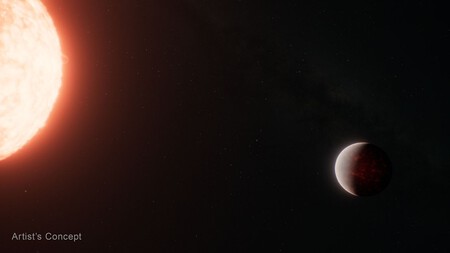
With a radius approximately 1.4 times that of Earth, TOI-561 b is an extreme super-Earth that orbits a star located about 280 light-years away, in the constellation Sextans. NASA describes it as the innermost planet in a system made up of four worlds, completing an orbit in less than eleven hours. Its proximity is so extreme, barely 0.01 astronomical units, that the daytime hemisphere greatly exceeds the melting point of rocks. It seems to be tidally locked, with one side perpetually bathed in sunlight and the other shrouded in darkness.
The Mystery of Its Low Density
One of the most intriguing aspects of TOI-561 b is its low density. Johanna Teske, lead author of the study, clarifies, “It is not a super-puff, but it is less dense than one would expect with a composition similar to that of Earth.” The research team hypothesized that the planet might have a small iron core and a mantle composed of less compact minerals. Given its host star’s age and composition, it is plausible that the planet developed in a primordial environment distinct from that of the Solar System.
The Enigma of the Dense Atmosphere
Despite these findings, the exotic composition did not answer all questions. Researchers considered another possibility: TOI-561 b might retain a thick atmosphere. The reasoning here is compelling; models suggest that small planets subjected to intense irradiation for billions of years should have lost their gaseous envelopes long ago. However, some planets in similar conditions still show signs of atmospheres, hinting that TOI-561 b’s low density could be partly due to a substantial layer of gases.
Innovative Measurement Techniques
To explore the dense atmosphere theory, the team employed a technique utilized by James Webb on other rocky worlds: measuring the infrared glow as the planet passed behind its star. Using the NIRSpec spectrograph, researchers estimated the temperature of its illuminated hemisphere. If TOI-561 b were just a bare rock, its temperature would be around 2,700 ºC; however, observations revealed it to be around 1,800 ºC—a significant deviation.
Revolutionary Observations and Ongoing Research
This unexpectedly low temperature aligns with the hypothesis of a thick, volatile-rich atmosphere. Winds may redistribute heat from the scorching daytime side to cooler areas, reducing infrared emissions. Additionally, gases could absorb some radiation, helping maintain lower temperatures. Researchers even consider the possibility of silicate clouds that reflect stellar light and cool the upper atmosphere.
The study team’s observations are part of James Webb’s General Observers 3860 program, where the telescope tracked TOI-561 b for over 37 hours. This extensive data collection offers an unprecedented view of the planet’s brightness fluctuations, leading to new analyses that suggest a more intricate world than initially believed.
The case of TOI-561 b exemplifies how even the most extreme worlds hold surprises. With magma, atmosphere, and stellar radiation interacting in complex ways, Webb’s findings continue to challenge our understanding. As Johanna Teske remarks, “What’s really exciting is that this new dataset is opening even more questions than it’s answering.” As research progresses, we are only beginning to comprehend the diversity of planetary systems within our universe.