
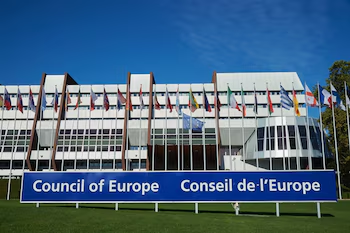
Council of Europe Urges Spain to Reevaluate Public Document Access
The Council of Europe, through its Access to Information Group (AIG), has advised Spain to reflect on its reservations regarding access to public documents. The latest report indicates that while Spain’s Transparency Law conforms to the Convention on Access to Public Documents, there are essential changes necessary to improve the process for citizens.
Overview of the Transparency Law
The Transparency Law in Spain, which went into effect in January 2024, aligns with the Tromsø Convention—a critical international legal framework guaranteeing citizens the right to request access to public administration documents. The AIG’s findings confirm that Spain’s law covers all public authorities and maintains most limitations on access in line with international standards, but they emphasize the need for improvements.
Evaluating Public Interests
According to the report, independent experts support the case-by-case evaluations mandated by the Transparency Law, which prioritize the public interest when determining whether to release requested documents. They commend the process’s lack of excessive formalities, making it easier for citizens to submit requests for information.
Recommendations for Changes
One of the significant reservations highlighted by the AIG is found in Article 18(b) of the Transparency Law. It currently states that requests for “auxiliary or supportive information,” like notes and internal communications, will not be processed. The report strongly recommends that Spain reconsider this restriction. Furthermore, the AIG expressed concerns regarding reservations connected to statistical confidentiality and sensitive tax information. They propose that Spain re-evaluate these reservations and consider withdrawing them for improved transparency.
Shortening Deadlines for Requests
Another critical aspect addressed in the report pertains to the processing deadlines for access requests. While Spanish authorities currently have up to a month to respond to requests, the AIG believes this timeframe gives too much discretion and is not in line with the Convention’s standards for promptness. They advocate for shortening these deadlines, suggesting that authorities act as quickly as “reasonably possible” when they do not plan to deny access.
The experts are skeptical that a one-month timeframe is reasonable for decisions on access to public documents, especially when no limitation applies. They also critique the additional time extension of 15 days for third-party involvement or up to a month for complex requests, advising this should only occur in extraordinary situations.
Conclusion: A Call for Action
The AIG acknowledges the Spanish Government’s explanation that the one-month period is a maximum, often leading to quicker responses in practice. However, the report highlights that these legal deadlines leave too much room for discretion, emphasizing the need for a review. This is a pivotal moment for Spain to enhance public trust and ensure transparency in its administration. The recommendations from the Council of Europe can significantly open channels of communication between the government and its citizens, reinforcing the democratic ideals of access to information.