
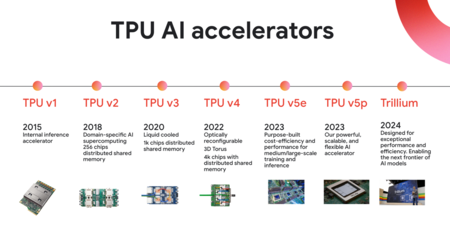
In 2013, a pivotal moment occurred at Google, led by director Jeff Dean. He and his team realized that increasing usage of Android’s voice search needed more computational power, necessitating a significant expansion of data centers. During this time, Google was reliant on standard CPUs and GPUs, but the urgency prompted them to venture into creating custom chips.
This initiative birthed Google’s first Tensor Processing Unit (TPU), an ASIC tailored for executing neural networks that enhanced voice services. By 2015, these TPUs powered essential Google offerings like Maps, Photos, and Translate. Fast forward a decade, and Google’s TPUs have evolved into formidable contenders, inadvertently shaking NVIDIA’s long-held dominance in the AI chip market.
Google TPUs Keep Their Promise
Historically, AI companies have leaned heavily on NVIDIA’s GPUs to train their models. However, recent developments indicate a notable shift in this paradigm.
The launch of Claude Opus 4.5 demonstrated this change, marking a significant advancement in programming tasks. Anthropic, the developer behind Claude, declared that this model no longer relies solely on NVIDIA; it harnesses the capabilities of NVIDIA, Amazon’s Trainium, and Google’s TPUs alike.
Additionally, Google’s latest Gemini 3 AI model was exclusively trained using the Ironwood TPUs introduced in April 2025, underscoring their growing significance.
What began as a response to internal demands has now positioned Google to capitalize on advancements in AI technology. The timing could not have been better; the debut of ChatGPT propelled Google’s TPUs into the spotlight, amplifying their role in training and inference tasks.
Ironwood TPUs: The Game Changer
The current generation of Ironwood TPUs boasts remarkable performance and efficiency. Compared to their predecessors, they deliver double the FLOPS performance per watt, a significant enhancement achieved through rigorous development.
The TPU v5p of 2023, for example, achieved 4,614 TFLOPS—10 times the capacity of earlier models. This leap in performance is crucial as the AI landscape becomes increasingly competitive.
2025: A New Era of Collaboration
In a transformative move, 2025 marked the year Google decided to share its TPUs with other companies. Agreements with industry players like OpenAI and Anthropic signify a strategic shift. Google isn’t just leasing computing power; it is also facilitating the sale of hardware, with plans to supply one million TPUs, including 400,000 Ironwood units via Broadcom and 600,000 through Google Cloud (GCP).
Reports indicate that Ironwood TPUs exhibit capabilities comparable to NVIDIA’s Blackwell chip in terms of FLOPS and memory bandwidth. The true advantage, however, lies in cost-effectiveness—the Total Cost of Ownership (TCO) for Ironwood servers is up to 44% lower than their NVIDIA counterparts, providing Google with a competitive pricing edge.
NVIDIA’s “Moat” is Narrowing
NVIDIA’s strength has traditionally rested on its software platform, CUDA, recognized as the industry standard for AI development. However, Google is making strides to disrupt this status quo.
By prioritizing native support for frameworks such as PyTorch—historically a cumbersome process on Google TPUs—Google is making it simpler for developers to transition to its hardware, effectively lowering barriers to entry.
Moreover, Google is advancing its inference ecosystem support, making it more compatible with existing tools in the AI community, further positioning its TPUs as a viable alternative to NVIDIA’s offerings.
The Future Landscape of AI Chips
Currently, Google is positioned as a serious challenger to NVIDIA in the AI chip manufacturing arena. No longer merely a cloud service provider, Google is evolving into a complete solutions vendor, offering competitive performance, scalability, and a promising software roadmap.
This newfound direction poses significant challenges for NVIDIA, prompting the question: how will NVIDIA respond to this formidable competition? As the landscape continues to evolve, tech enthusiasts and investors alike will be keen on monitoring this unfolding rivalry.