
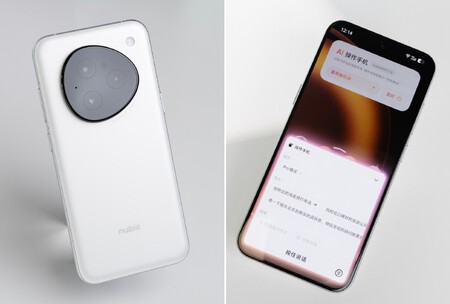
The Future of Mobile Interaction: ZTE’s Nubia M153
Many technology enthusiasts have spent years imagining a future where mobile phones can execute commands simply through voice. Why navigate apps when you could just say, “Mark all messages as read” or “Order a car from my location”? This dream scenario envisions an AI agent managing tasks effortlessly, eliminating the need for screen interaction.
A Leap Towards Agentic AI
Recent advancements in technology, however, haven’t fully realized this dream. Despite significant progress in AI, interactions with our mobile devices often remain traditional and cumbersome. Leading platforms haven’t introduced user experiences that match the expectations set by bold predictions. ZTE, recognizing this gap, has taken a groundbreaking step by integrating a sophisticated AI agent, known as the Nubia M153.
The Nubia M153: A Game Changer
The mobile that turns agentic AI into its core. Unlike existing assistants, the Nubia M153 features a deeply integrated AI solution. According to the Global Times, the device includes a preview of Doubao Mobile Assistant, jointly developed by ByteDance and ZTE. While the assistant is still being refined, it already showcases an impressive ability to interact with various applications and carry out tasks without user intervention.
Real-World Demonstrations
Various demonstrations of the Nubia M153 have quickly gained attention online. Users have showcased its functionalities on platforms such as X. For example, one user simply asked the assistant to hire someone to wait in a queue—common in China—and the agent executed the task autonomously. In another instance, a user provided a photo of a hotel, and the assistant promptly reserved a room at the best available rate.
On Weibo, the versatility of the assistant continues to impress. A user requested, “Order me three lattes and a Mixue ice cream,” and the assistant immediately began processing the request, filling in details like size and sugar level. It could also tackle multiple tasks, such as locating the cheapest pizza service, buying movie tickets, or generating AI-based images from photos.
An Exclusive Offer
An experiment that has exceeded expectations. The Nubia M153 is not targeted at mass markets; instead, it’s available in China and produced in limited quantities. Reports indicate that ZTE released approximately 30,000 units, specifically aimed at tech-savvy users eager to explore new assistant capabilities. Priced at 3,499 yuan (around 425 euros), the phone sold out just hours after its launch on December 1.
Specifications and Design
Under the hood. According to IT Home, the Nubia M153 is powered by a Qualcomm Snapdragon 8 Ultra processor, accompanied by 16 GB of RAM and 512 GB of storage. The 6.78-inch LTPO screen boasts a resolution of 1264 x 2800 pixels. For photography enthusiasts, its camera system features three 50 MP sensors—main, wide-angle, and telephoto—all wrapped in a sleek design characterized by a white back cover and rounded edges.
Navigating Challenges Ahead
Are we ready for the agentic era? The launch of the Nubia M153 also highlighted some challenges. Following the release, several users began reporting suspicions regarding account activity on popular platforms like WeChat, Alipay, and Pinduoduo. These issues indicate that the assistant’s autonomous operations triggered security protocols aimed at preventing unusual behavior patterns typically not associated with human users. This situation reflects a preliminary tension between state-of-the-art AI agents and the traditional platforms that dominate China’s digital landscape.
Images | ZTE