
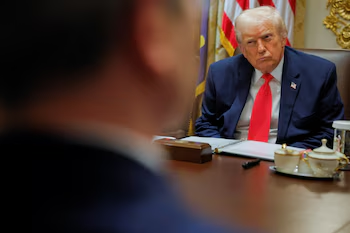
Trump’s Stark Warning on Drug-Exporting Countries
A Bold Declaration
Recently, U.S. President Donald Trump made headlines by declaring that any country manufacturing and exporting fentanyl or cocaine to the United States is “subject to attack.” This remark reflects his ongoing stance toward countries he views as responsible for the ongoing drug crisis in the U.S., particularly Mexico.
During a press conference at the White House, Trump was questioned about the military’s role in combating drug trafficking. His response indicated that not only Venezuela might face U.S. military intervention but also other nations implicated in the drug trade. “If they enter through a certain country or any country, if we believe that they are building factories, anyone who does that and sells it in our country is subject to attack,” Trump asserted.
Targeting Drug Manufacturing
Trump further focused on Colombia, which he claims is producing cocaine for the U.S. market. “I have heard that Colombia, the country of Colombia, is producing cocaine, they have cocaine plants,” he stated. His remarks underscore a broader narrative that links foreign drug production to domestic challenges in the United States, advocating for stronger actions against the alleged cartel-driven drug trade.
Venezuela: A Specific Case
Venezuela, in particular, has drawn Trump’s ire. He described the nation as “very bad” and accused it of sending drug traffickers to the U.S. Trump emphasized that the situation with Venezuela is particularly dire but also acknowledged that it is not the only country where U.S. forces may take action.
Mexico’s Rebuttal
Despite Trump’s aggressive statements, Claudia Sheinbaum Pardo, President of Mexico, has firmly denied any possibility of military intervention on Mexican soil. In numerous public addresses, she has insisted that Mexico will not seek assistance from the U.S. government for its internal security challenges. As Sheinbaum articulated: “We can collaborate, but we do not accept the intervention from any foreign government.”
This indicates a significant diplomatic tension between the two nations, as Mexico seeks to maintain its sovereignty while grappling with drug cartels and their influence.
Conclusion: A Complex Landscape
As Trump’s aggressive rhetoric continues to make waves, the international community watches closely. The potential for military actions raises several concerns regarding sovereignty, international law, and bilateral relations. While the intention to combat drug trafficking is shared, the means and methods remain contentious.
The drug crisis in the United States is not just a domestic issue; it involves multiple countries and complex geopolitical dynamics. As Trump’s administration infers possible airstrikes and other military actions, countries like Mexico and Colombia are left to navigate the treacherous waters of international diplomacy, all while tackling their internal drug-related issues.
Information in development…