
Political Exclusion and its Impact
The recent exclusion of Domingos Simões Pereira, the historical leader of the African Party for the Independence of Guinea and Cape Verde (PAIGC), marks a significant shift in the political landscape of Guinea Bissau. For the first time since 1974, the PAIGC is absent from the presidential race, leading to increased political tension. This exclusion has prompted the PAIGC to endorse Fernando Dias of the Social Renewal Party (PRS) as their candidate against incumbent President Umaro Sissoco Embaló. The abrupt shift has polarizing effects, enhancing existing divisions within the electorate.
Election Day: Tension and Oversight
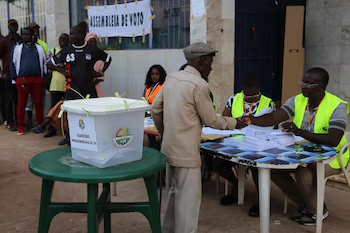
More than 965,000 citizens are expected to participate in the polling process, which will determine both the next presidential leader and the composition of the National People’s Assembly, consisting of 102 seats. Voting is set to occur from 7:00 a.m. to 5:00 p.m. with heightened security measures due to a history of political violence and coup attempts in recent years. Following unrest in December 2023, authorities have reinforced security to maintain order and minimize disruptions at voting centers.
Historical Context
Umaro Sissoco Embaló’s tenure, which began in February 2020, has been fraught with institutional challenges, including two coup attempts. If he secures re-election, Embaló could become the first president in Guinea Bissau’s history to serve consecutive terms—a notable feat in a political atmosphere characterized by instability.
Candidates and Political Dynamics
Several candidates are vying for the presidency this election day, including notable figures such as former President José Mário Vaz and Baciro Djá, a former Prime Minister. However, the fragmentation of the political spectrum due to the absence of historically significant parties like the PAIGC complicates the electoral dynamics.
Complaints of Institutional Interference
The electoral environment is overshadowed by accusations of interference and a lack of transparency. Opposition parties have raised serious concerns regarding the National Electoral Commission and the Supreme Court, positioning them as entities that favor the ruling party. A significant component of electoral integrity—a neutral and trusted oversight mechanism—is perceived to be lacking.
Social Divisions and Security Presence
The social landscape is equally divided, with supporters of Embaló highlighting his efforts against corruption and drug trafficking, while detractors critique his management of public services and public security. The ongoing political discourse calls for a clear separation between military authority and civil governance, highlighting the pressing need for reform.
Media Restrictions and Information Access
The electoral process has been marred by censorship, with journalists from prominent Portuguese channels expelled just months prior to the elections. This action has heightened concerns about the freedom of the press, effectively narrowing the flow of critical information to voters. Media coverage remains limited, perpetuating an atmosphere of mistrust regarding the electoral process.
Looking Ahead: Future Implications
The National Electoral Commission’s procedures specify that if no candidate achieves more than half of the valid votes, a second round of voting will occur. Preliminary results are expected within 48 hours of polls closing. International observers are closely monitoring the election, understanding that the outcome will significantly influence Guinea Bissau’s stability going forward.
Conclusion
The unfolding electoral process in Guinea Bissau echoes a broader narrative of instability and governance challenges. The actions of political parties, electoral bodies, and security forces are pivotal in determining the immediate future of a nation still grappling with its democratic identity.