
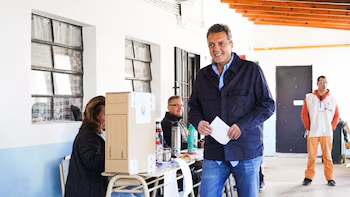
Massa’s Plans for 2026: Reconnecting with the Electorate
In recent years, Sergio Massa has adopted a lower profile, contrasting sharply with his prior visibility in Argentine politics. While he may seem distanced from the media spotlight, his influence within Peronism, particularly in Buenos Aires, remains significant.
The Current Political Landscape
In the last election, Massa opted not to run, emerging only in the final stages of both the provincial and national campaigns. His presence was felt during moments of elation and despair, from a notable victory on September 7 to a disappointing defeat by a mere 20,000 votes on October 26. He finds himself caught between prominent figures Cristina Kirchner and Axel Kicillof, despite his desire to maintain a degree of separation from their contentious relationship. Massa’s observations reveal a widespread sentiment in Peronism: internal conflicts need resolution to avoid alienating the electorate.
The Challenge of Internal Conflict
Massa has expressed that the ongoing internal strife within Kirchnerism not only complicates provincial governance but also hampers national political cohesion. As Buenos Aires constitutes 40% of the voter base, harmony within its political framework is crucial for any successful national strategy. Until these issues are addressed, the perception of politics as a detached game from everyday citizen concerns will likely persist.
A Call for Unity and Focus
Massa advocates for a quieter, more constructive end to the year, urging members to prioritize legislative essentials—approving debts and budgets—over internal disputes. He aims to reinforce unity within his political bloc, asserting that the impulse to act hastily can undermine collaborative efforts. The incessant rumors regarding potential splits in the Fuerza Patria bloc reflect a climate of uncertainty that needs addressing.
Looking Forward: Defining Peronism’s Future
Massa envisions 2026 as a pivotal year for Peronism, one in which a comprehensive discussion regarding the party’s identity and values is essential. Friction within the party, especially concerning Kirchner’s role, reflects a broader conflict over who should lead moving forward. As Massa endeavors to distance himself from the chaos of Kirchnerism, he seeks to amplify the Justicialist model while critiquing the current national government’s approach.
A Modernized Political Agenda
Massa recognizes the importance of candid discussions on pressing themes such as the role of SMEs versus cooperatives, the state of public education, and the impact of emerging technologies on the workforce. He encourages his peers not to oppose reforms simply for opposition’s sake but to present viable alternatives backed by the Peronist ideology.
This perspective gained traction among Peronist leaders following previous electoral setbacks, emphasizing the need for an updated discourse and an expanded political project that resonates with a broader audience.
Building Alliances and Expanding Horizons
Massa understands that the political landscape has shifted. The strategy moving forward must focus on unifying and solidifying alliances beyond traditional Peronist boundaries. He stresses the importance of finding common ground through programmatic agreements with various stakeholders, prioritizing substance over mere visual camaraderie.
Conclusion: A Defining Path Ahead
As 2026 approaches, Peronism faces a critical juncture. The challenge will be to assemble a political project that not only captures the electorate’s interest, but also genuinely addresses their needs. Massa is convinced that for Peronism to thrive, it must rethink its foundational strategies, expanding its appeal beyond the confines of its historical identity.