
In recent years, the PC landscape has been undergoing a transformation, largely fueled by advancements in artificial intelligence (AI). The introduction of Copilot+ PCs aimed to revolutionize how we interact with our computers, promising a sleeker, more intuitive user experience. Yet, despite the lofty promises, the impact of these innovations on PC sales has been largely disappointing.
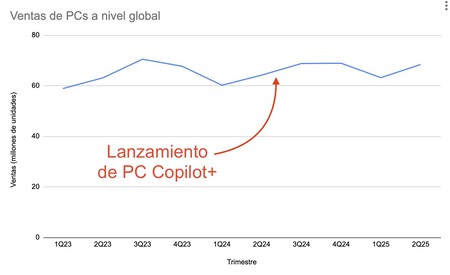
The initial hype surrounding Copilot+ PCs suggested a significant shift in consumer behavior, with many expecting a surge in sales. AI was touted as a game-changer, capable of streamlining tasks that typically consume our time. Many industry analysts believed that such features would not only boost typical PC sales but also siphon off some of the loyal Mac user base.

     <span>Own elaboration. Data: IDC</span>
  </div>
Despite these projections, the overall sales performance of PCs has not shown the expected growth trajectory. Market analysis indicates that neither PCs nor Macs have experienced significant fluctuations in sales, indicating that while the technology has advanced, buyer sentiment remains somewhat static.
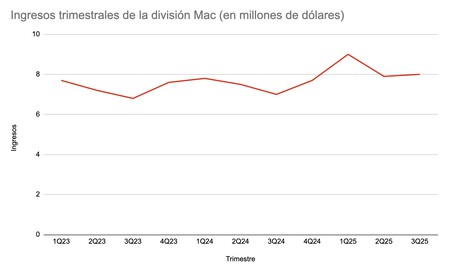
Interestingly, while AI features promised to make a compelling argument for purchasing new PCs, sales statistics do not mirror that optimism. Apple, in contrast, has taken a more cautious approach towards AI integration. Their systems have incorporated some level of Apple Intelligence , first introduced in June 2024; however, functionalities remain limited more than a year later.
     <span>Own elaboration. Data: Apple quarterly reports.</span>
  </div>
Consumers continue to purchase Macs at a steady rate, not necessarily due to Apple Intelligence , but because of the inherent value and desirability of the brand. This loyalty has translated into stable sales figures, indicating that brand loyalty plays a crucial role in Apple’s success.
The Mac is a lot of Mac
The recent introduction of the MacBook Pro M5 is anticipated to invigorate sales later in the year. However, the true star product appears to be the MacBook Air M4, which offers an excellent price-performance ratio and has garnered considerable attention in the market.
In the U.S., customers can acquire it for approximately $800 (excluding taxes). In Europe, it’s available for 949 euros . Comparatively, few Windows laptops can match the performance and value provided by Apple’s offerings, particularly with its M4 chip driving performance.
For instance, testing the Acer Swift Go 14 AI reveals it is priced at 719 euros, boasting 16 GB of RAM and a 512 GB SSD. However, its Qualcomm Snapdragon X Plus chip falls short of the Apple M4’s capabilities, scoring about 2,400 points in Geekbench single-core tests compared to the M4’s impressive 3,600. Additionally, the multi-core performance differs significantly, with the Acer achieving around 10,500 points to the Apple M4’s 15,000.
Despite the promise of Copilot+ PCs , which on paper appear competitive, they still lack the decisive edge that consumers are looking for in AI functionalities. Although these features exist, they are not convincing enough yet to drive significant sales increase.
While it is possible that PC sales could see a resurgence in the near future, this may not be directly due to AI innovations. With official support for Windows 10 concluding, many organizations and individuals may feel compelled to upgrade their systems, potentially fueling renewed interest in new devices.
    <img alt="The Copilot+ PCs promised a revolution. I have tried one and at the moment there are more promises than realities" width="375" height="142" src="https://i.blogs.es/0e52ab/acer-ia/375_142.jpeg"/>

  </div>
</div>
Ultimately, the expectation that AI would radically transform our PC experience remains unfulfilled. Apple , however, maintains its confidence in this fluctuating market, having reported a 13% revenue growth in its Mac division compared to the same timeframe last year. Despite the ongoing technological advancements, it seems there is still much ground to cover before the promise of AI in PCs becomes a reality.
In Xataka, we note that Microsoft is already envisioning what computers will look like in 2030, concluding that touch interfaces are overrated . The journey towards innovation continues to unfold, with anticipation surrounding future developments.
Image | Wesson Wang