
Today, civil supersonic flight is a distant memory , a feat that left more questions than certainties after the end of Concorde. The industry shifted its focus to efficiency and autonomy , sidelining the dream of crossing continents faster due to the controversial sonic boom noise that limited these aircraft’s operations. However, this dream is regaining traction, not with grandiose promises, but with a clear objective : to demonstrate that it is possible to fly faster than sound without disturbing those on the ground.
This resurgence is no longer a mere intention expressed in documents or a static prototype. On October 28, 2025 , the X-59 took to the skies for the first time since its inception, departing from Palmdale, California, and successfully landing at NASA’s Armstrong Center in Edwards. This flight was intentionally restrained, aimed at validating systems and basic flight behaviors. After landing, Lockheed Martin confirmed that “the X-59 performed exactly as planned,” signaling that the project has entered a phase where testing replaces mere mockups and promises.
The Project That Aims to Change Five Decades of Aviation Rules
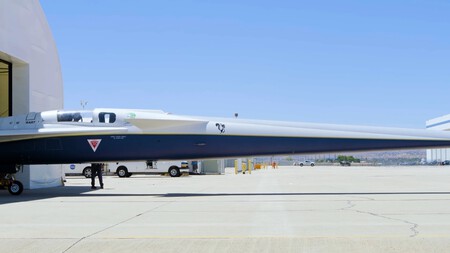
The X-59 is a technological demonstrator developed by NASA in collaboration with Lockheed Martin, aimed at overcoming the largest obstacles to civil supersonic flight: noise. Unlike the boom that has confined these aircraft for decades, the X-59 strives to produce a much softer “hit.” Its elongated and streamlined fuselage, centrally located cabin, and a cutting-edge 4K external vision system (instead of a traditional cockpit window) are crucial components of this goal. It is not designed to be a commercial aircraft; instead, its purpose is to gather the data that could enable such aircraft in the future.
The initial flight was deliberately cautious. NASA had anticipated that this outing would focus on testing the integration of systems, stability, and communications without diving into high speeds or extreme altitudes. According to the flight plan, it was a controlled circuit at low altitude and low speed to validate essential functions: ensuring that the aircraft responds correctly, that telemetry flows smoothly, and that controls behave as intended. Supersonic flight will follow in later testing stages.
The aircraft was officially presented in January 2024 at the Skunk Works facilities.
The journey to this historic first flight has been lengthy. NASA initiated the project in 2016 , with the original goal set for takeoff in 2020 , which was delayed due to technical challenges that arose in 2023 . The plane was officially unveiled in January 2024 at the Skunk Works facilities. Throughout the year 2025, extensive testing included engine assessments , integration checks, and ground rehearsals. On July 10 of that year, test pilot Nils Larson conducted the first low-speed taxi test, marking the end of the ground phase.
From here, the program progresses methodically. Further verification flights will occur, with speed and altitude increasing gradually until the target supersonic regime of Mach 1.4 is reached. NASA and Lockheed Martin will collect both aerodynamic and acoustic data during this phase at the Edwards base. Subsequently, the aircraft will fly over inhabited areas to gauge public reaction, a critical step in conveying results to regulators.
Beyond the technological aspects, the challenge of supersonic flight also involves regulatory hurdles. In the United States, passenger flights exceeding Mach 1 over land have been banned since 1973 due to their acoustic impact . Other countries impose similar restrictions. The Quesst program endeavors to provide scientific evidence that can lead to a reevaluation of these rules, basing it on empirical measurements rather than conjecture. If NASA can effectively demonstrate that the noise produced by the X-59 is within tolerable limits, civil aviation may reclaim some ground lost post-Concorde.
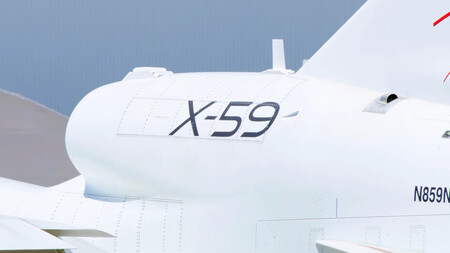
It is crucial to clarify that the X-59 is not a prototype for a future passenger aircraft. It primarily serves as a test bed . It will not transport civilians nor will it be available for commercial sale; its primary function is to generate evidence regarding the feasibility of silent supersonic flight . NASA aims to use the acoustic and sociological data collected to inform regulatory adjustments . Should the industry find the regulatory landscape favorable, commercial designs inspired by this project could emerge—though that reality is still a distant prospect.

As the project progresses, each flight will yield valuable information that will determine whether the X-59 initiative has a future beyond research. The critical factors will not be maximum velocity, but rather the sound footprint and the social response produced by flights over real communities. Only when comprehensive data is available will regulators decide if it is time to revisit the rules that have changed little since the 1970s. Although the project does not promise a new Concorde, it does offer the possibility of opening doors that previously seemed forever closed.
Images | Lockheed Martin (1, 2)
In Xataka | The Comac C919 symbolizes China’s aerial dream: the trade war threatens to clip its wings in mid-takeoff.