

Last week, NASA’s acting administrator proposed studying alternatives to SpaceX’s Starship to send astronauts to the Moon before China does. SpaceX has just published a blunt response.
A paradigm shift. The self-imposed moon race against China has made the United States forget the real reason why NASA chose SpaceX’s gigantic Starship for its return to the Moon.
As SpaceX itself has been responsible for reminding us in a long publication loaded with images, technical details, and advances, its Starship HLS (Human Landing System) is not merely a lunar landing module like that of the Apollo missions; it is a paradigm shift designed to construct a permanent lunar base .
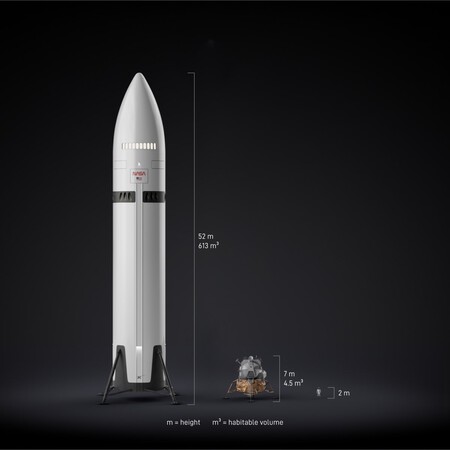
Size comparison between Starship HLS and the Apollo lunar module
This is Starship HLS. The comparison is almost comical . While the Apollo lunar module, which took the first humans to the Moon, measured seven meters high, Starship HLS will rise vertically to 52 meters .
In terms of space, the Apollo lunar module had a habitable volume of a wardrobe, approximately 4.5 cubic meters . In contrast, the Chinese Lanyue spacecraft, designated for its astronauts, has twice the volume. Starship, according to SpaceX , boasts two-thirds of the pressurized volume of the entire International Space Station at 613 cubic meters .
Moreover, the SpaceX ship will possess two airlocks for surface exits, each with a habitable volume of 13 cubic meters . Essentially, a single Starship airlock is more spacious than the Chinese lunar landing module, raising concerns for NASA.
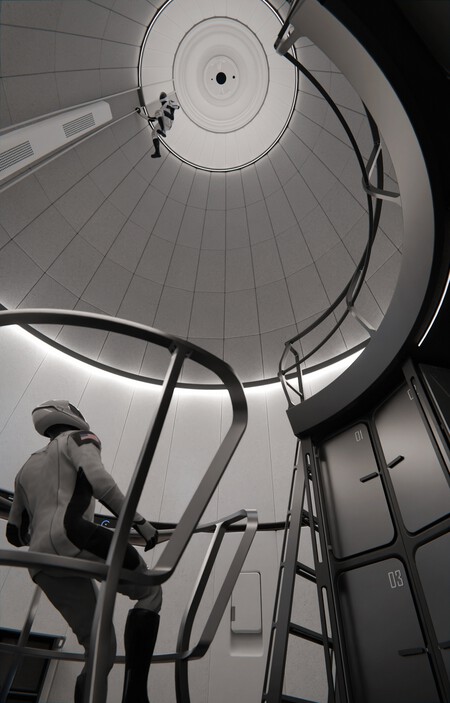
Render of the interior of Starship HLS
A luxury apartment. If the size comparison isn’t convincing enough, the new renders of Starship’s interior reveal a comfort level that no spaceship has ever had outside of sci-fi movies .
Gone are the images of astronauts squeezed into an aluminum can. The ambitious design includes a spacious, multi-story interior with a clean, futuristic aesthetic. It features a spiral staircase, a control area with multiple seats, and a panoramic window offering breathtaking views of the lunar surface.
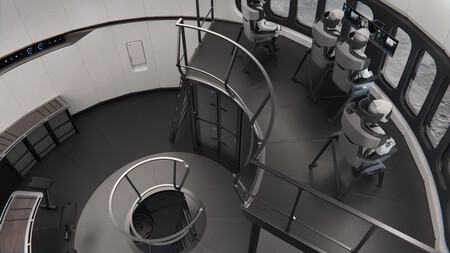
Astronauts inside Starship HLS
A beast of burden. Starship is not designed simply to carry new American flags to the Moon. Instead, SpaceX has reiterated its commitment to fulfill the initial promise of NASA’s Artemis program : to establish a “permanent and sustainable presence on the Moon” by building a lunar base.
Starship’s cargo variants are capable of landing up to 100 tons on the lunar surface. This includes both pressurized and non-pressurized rovers, nuclear reactors for power generation , and prefabricated lunar habitats that NASA aims to have installed before China does.
2026 will be the moment of truth. SpaceX claims it has completed 49 key milestones in Starship’s development, which encompasses demonstrations of life support systems, testing landing legs, and validating the docking adapter.
Nevertheless, the significant challenge remains: refueling ships in orbit to counteract the evaporation of cryogenic fuel . SpaceX seeks to tackle this issue by 2026 with its new Starship V3 model. Without effective fuel transfer in orbit, Starship will be unable to reach the Moon with both crew and significant cargo.
Images | SpaceX
In Xataka | The enormous size of Starship, in images that illustrate its scale
In Xataka | A genius named Tom Mueller designed the engines for the Falcon 9. And now that genius wants to beat SpaceX on its own turf.