
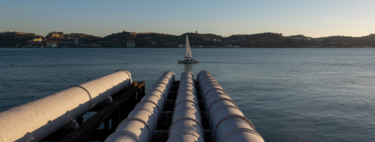
Winter’s Energy Challenges Loom in Europe
As the cold months approach, the European energy market is already feeling the strain. Recent developments indicate that this winter may not unfold smoothly, primarily due to issues concerning liquefied natural gas (LNG) regasification capacity. The ongoing challenges are not merely a continuation of previous problems linked to Russian gas pipelines, but new complexities that are shaping the landscape.
The coming winter’s threat. Analyst Pedro Cantuel highlighted essential insights into the situation: “The most important regasification plants in Europe, those in the Netherlands, are operating at maximum capacity.” This saturation not only represents a logistical dilemma but also hints at the economic repercussions that could follow—a worrying sign for consumers across Europe.
This situation has far-reaching implications for gas pricing. With the central terminals serving as the main gateways for LNG to reach the industrial heart of Europe, their saturation is a precursor to potential cost increases . Given that gas prices heavily influence electricity bills across the continent, this development warrants serious attention from policymakers and citizens alike.
The role of Spanish regasification plants. Spain boasts the largest regasification capacity in the European Union, housing six active terminals. However, its ability to ease Europe’s energy crisis is limited. The primary issue is the inadequate gas interconnection with France, referred to as the bottleneck of the Pyrenees . This existing infrastructure allows only a modest yearly export volume of between 7,000 and 8,500 million cubic meters , which is insufficient to meet the growing demand.
This places significant pressure on the Netherlands, where terminals such as Gate in Rotterdam and Eemshaven serve as crucial entry points for gas to Germany and its surrounding industries.
By the numbers. The Netherlands has emerged as the dominant LNG importer in the EU, regasifying over 2,000 million cubic meters of gas from June to August 2025. However, recent observations reveal that the country’s regasification facilities are frequently reaching their maximum capacities. According to data from Gas Infrastructure Europe, the demand continues to exceed supply.
With Dutch ports nearing saturation, complications are likely to arise for Germany, which increasingly relies on the Netherlands for its gas—now accounting for 25% of its imports since sanctions against Russia took effect. When the terminals consistently operate at near-full capacity, any sudden spike in demand due to colder weather or any delays in LNG shipments could lead to significant strains on the entire system.
Impact on energy bills. Historical trends show a clear correlation between difficulties in natural gas access and price surges. The Agency for the Cooperation of Energy Regulators reports that high utilization rates of LNG terminals in northwest Europe are directly linked with increased volatility and disparities in gas pricing throughout the region. We’ve transitioned from depending on a singular supplier—Russian gas pipelines—to relying heavily on spinal infrastructures that could now become new bottlenecks, namely the ports.
To address these issues, initiatives are already underway to expand port capacity. Notably, Gate is constructing a fourth tank , aiming to increase its capacity to 20,000 million cubic meters per year. Nevertheless, this project will not be completed until 2026 , leaving the current situation unaltered for this winter: the system is operating at peak capacity.
Image | Vopak
In summary, as winter approaches, it becomes increasingly imperative for European countries to strategize effectively in managing their energy resources. Addressing infrastructure limitations, securing necessary imports, and anticipating market fluctuations will be crucial to ensuring that citizens are not left in the cold.