
How AMD’s Journey Began: From Copying to Creating
Today, AMD (Advanced Micro Devices) stands as a powerhouse in the semiconductor industry, offering some of the most advanced chips globally. The company’s legacy of innovation is remarkable, yet its origins trace back to a rather audacious act: the bold copying of an Intel chip.
Leave me that microscope. In the summer of 1973, three engineers— Ashawna Hailey , Kim Kailey , and Jay Kumar —left their positions at Xerox . They wanted to bid farewell with a bang, leading to a daring venture on their final day: they disassembled an Intel 8080 microprocessor and, using a microscope, captured a staggering 400 images of its die.
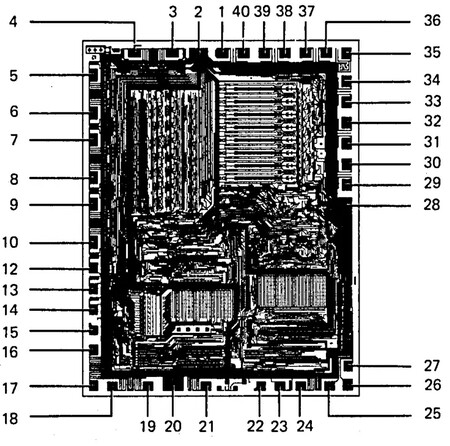
Reverse engineering. Those images allowed the engineers to decipher the design and architecture of the groundbreaking processor through reverse engineering . With their schematics and logical diagrams, they sought interest from various companies in Silicon Valley .
The origin: Am9080. Eventually, AMD seized the opportunity. At this time, the company was nascent, having just developed an N-channel MOS process for chip manufacturing. By integrating this manufacturing technology with the reverse-engineered schematics, they launched the Am9080 . While some sources state that sales began in 1974, mass production didn’t truly kick off until 1975, marking 50 years since.
They cloned it and improved it. In a revealing 1997 interview, Hailey and Kailey explained that the AMD chip was a remarkable success . It produced 10 times more efficiently than Intel’s, yielding 100 dies per wafer . Moreover, it was four times more powerful than the Intel 8080.
They made them for 50 cents, they sold them for 700 dollars. The astonishing success of the Am9080 translated into a surge in demand, particularly from the military and defense sectors. Each Am9080 cost an estimated 50 cents to manufacture but sold for an impressive 700 dollars , resulting in a phenomenal profit margin.
Intel ended up making a deal. This success positioned AMD as a significant player in the semiconductor market, ultimately leading to a cross-licensing agreement with Intel. This agreement enabled AMD to become a “second source” for Intel’s processors, fostering a mutually beneficial relationship.
Why did Intel allow something like this? The agreement wasn’t born out of generosity. During that period, securing lucrative contracts with defense agencies necessitated having a backup supplier who could manufacture chips if the primary source encountered issues.
Here peace and then glory. The conclusion was a deal where AMD paid Intel a mere $25,000 to sign, plus an annual fee of $75,000 for the licensing rights—minuscule sums in the grand scheme. This agreement also shielded both companies from potential past legal issues.
And finally, x86. This initial partnership was crucial in leading to a more significant agreement in 1982, allowing AMD to produce its own x86 chips . This marked a major turning point as it enabled AMD to develop its versions of chips using that architecture, starting with the Am286 , a licensed iteration of Intel’s 80286.
The rest, as they say, is history. This pivotal agreement transformed AMD into a formidable alternative to Intel, although for many years, it operated in the latter’s shadow. However, AMD expanded into the graphics card market, which significantly lifted its valuation. Today, AMD boasts a market capitalization of $410 billion , ranking as the 25th largest company globally, while Intel, struggling, sits at the 96th position with a capitalization of $182 billion .
It’s remarkable to think that this entire journey began with a few photographs taken under a microscope. AMD’s story is a testament to the power of innovation and ambition in the tech world.