
The Global Internet Pricing Divide: An Examination of Disparities
Accessing the Internet has become an essential part of modern life. In our hyper-connected world, where we rely on digital applications for everything from communication to banking, having reliable Internet coverage and speed is more crucial than ever. Recent incidents, like the AWS server blackout, highlight just how much we depend on this connectivity. However, despite the global nature of the Internet, a significant digital divide still persists. This gap is evident in how dramatically prices for Internet access can vary from one region to another.
Some users pay as little as one cent per Mbps, while others face charges exceeding four euros for the same service level, illustrating a stark contrast in global Internet pricing.
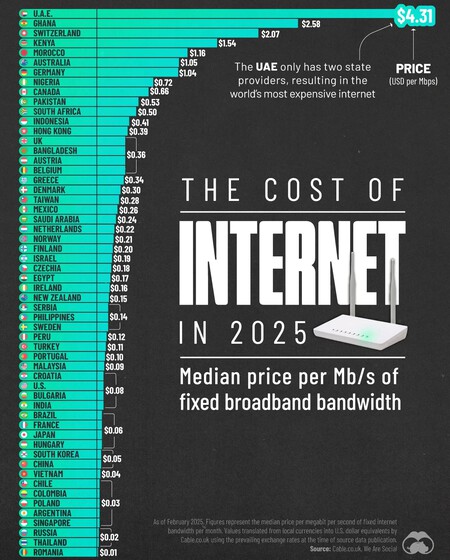
According to a graph presented by We Are Social and prepared by Visual Capitalist, the price of megabit per second (Mbps) varies widely across more than 60 countries in 2025. The global average price for Mbps hovers around 45 cents , while the price per Mbps also varies, with some countries reporting far higher or lower than the global average—often skewing the overall statistics.
This disparity can be attributed to several factors, including infrastructure , population density , market competition , and tax policies . Areas with low population density may find it expensive to deliver broadband Internet, whereas competition can drive prices down significantly.

A Closer Look: The United Arab Emirates. The United Arab Emirates serves as a prime example of how political factors and lack of competition contribute to high Internet prices. Current data indicates that the price of Mbps in the UAE stands at $4.31 , nearly double that of Ghana, which charges $2.58 . Emiratis pay between $100 and $140 monthly for Internet access, raising eyebrows about the underlying causes.
The duopoly of telecommunications companies in the UAE stifles competition, leading to a lack of incentive for cost reduction. Furthermore, government policies requiring operators to transfer up to 30% of their profits to the state further inflate consumer prices. Although the average speeds rate around 300 Mbps , the high cost remains a barrier for many, exacerbating the digital divide between rich and poor.
Contrasting with Romania. On the flipside of the spectrum sits Romania, where Internet prices are astoundingly low . The average cost for fiber optic services hovers around 10 euros , translating to just $0.01 per Mbps . This is largely due to the rapid deployment of decentralized fiber optic networks that began after the fall of communism. Competition from numerous private operators has enabled many Romanians to gain access to affordable high-speed Internet.
Estimates suggest that almost 90% of households in Romania now enjoy high-speed Internet. Companies like DIGI have exported this model beyond Romania, offering competitive plans in other regions like Spain, where they provide impressive speeds at reasonable prices.
Looking at Global Costs. Observing the price of Mbps worldwide reveals fascinating trends as several countries exceed the dollar mark for each Mbps:
- Switzerland: Average price is just over $2 per Mbps due to the dominance of a single operator and high maintenance costs associated with the country’s salary structure.
- Kenya: Costs average around $1.54 per Mbps, with poor fiber infrastructure creating reliance on alternative technologies like Starlink.
- Morocco: The $1.16 price reflects uneven distribution of infrastructure among just three dominating companies.
- Australia: The geographical dispersion leads to an average of $1.33 per Mbps, affecting rural connectivity.
- Germany: As a prominent European economy, it shows a perplexing average of around $1 per Mbps while lacking in speed and costing efficiency due to old infrastructure.
A Snapshot of Spain’s Internet Landscape. Within Europe, Spain offers a commendable example of affordable Internet access, where prices average about 10 cents per Mbps. Monthly packages of 1 Gbps are typically priced between 30-40 euros , and unlimited mobile data is becoming increasingly standard. The competitive landscape amongst various Internet service providers ensures that consumers benefit from reasonable rates.
Spain stands as a benchmark for fiber deployment efficiency, even extending its reach to rural areas. The regulated environment promotes cooperation among companies, leading to better service for all consumers, thus narrowing the gap between regions and enhancing connectivity.
As we analyze these global disparities in Internet pricing, it’s clear that many factors influence the cost, from governmental policies to competition levels, infrastructure development, and historical context. Understanding these parameters offers insights into the future of global connectivity and how to bridge the existing digital divide.