

The Surprising Speed of Human Brain Evolution and Its Implications
When we dive into the fascinating realm of human evolution , we find a complex puzzle. Though researchers have pieced together substantial insights over the years, many questions remain unanswered. Among these queries is a critical one: at what pace did the human brain evolve compared to that of great apes? A recent study from University College London has shed new light on this topic, revealing that humans evolved their craniofacial features and brain size at an astonishingly accelerated rate . This article will explore the study’s hypothesis , methodology, findings, and implications for our understanding of evolution.
The Hypothesis
The research team, led by Spanish scientist Aída Gómez-Robles , initiated their study from an accepted premise: modern humans possess brains nearly three times larger than those of our closest relatives, the great apes. Furthermore, this difference is not just in size but also in cranial structure . For instance, most great apes have forward-projecting faces and comparatively smaller brains, while humans feature a flatter face and a more rounded cranial shape.
The only exception among the apes is the gibbon , which has a rounded head but a significantly smaller brain. The researchers hypothesized that craniofacial adaptations in humans evolved rapidly due to the benefits affiliated with having a larger brain. They also suggested that social factors could have played a crucial role in this accelerated transformation.
The Study
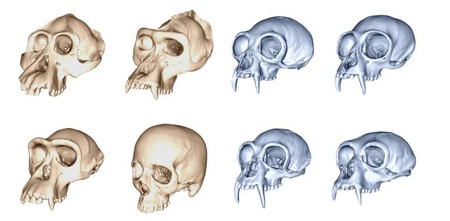
To verify their hypotheses, the team examined virtual models of skulls from several modern primate species. They analyzed skulls from seven species of great apes , including humans, two types of gorillas, two types of orangutans, chimpanzees, and bonobos , alongside nine species of hylobatids (lesser apes, like gibbons).
Utilizing advanced mapping techniques to pinpoint anatomical structures, the researchers divided each skull into four sections. They scrutinized facial markers, the upper and lower face, and both the front and back of the head, comparing the variations across all analyzed skulls.
The researchers included hylobatids as a control group since these species diverged from hominids approximately 20 million years ago . They found that while gibbons exhibited close similarities, hominids displayed significant diversity. Remarkably, among hominids, humans exhibited the most rapid evolutionary changes.
The Findings
The study’s outcome indicated that the evolution of the human brain occurred at twice the speed of that in other hominids. Although previous studies examined various factors influencing brain and skull evolution, this research is the first to quantify their comparative evolutionary speeds explicitly.
Moreover, researchers discovered that changes in the human face evolved almost concurrently with alterations in the neuroskull . While an increase in brain size and facial flattening appear linked, this relationship is not as evident in other species. The researchers concluded that external factors , possibly selective pressures from social living, significantly influenced these evolutionary changes.
The Implications
This phenomenon is not exclusive to humans. The researchers also found that gorillas displayed the second-fastest rate of cranial evolution, likely due to similar social selection pressures; a larger cranial crest tends to symbolize a higher social status within their communities.
While the UCL study advances our understanding of the evolution of the human brain , it also acknowledges that many pieces of the great evolutionary puzzle remain missing. Future research will likely delve deeper into biological and social factors that might have propelled the *accelerated cranial development* in humans.
In summary, this groundbreaking study highlights the accelerated speed at which humans have evolved compared to other hominids, emphasizing the potential role of social structures in shaping our anatomical evolution. As we continue to explore this intricate puzzle, each new discovery brings us a step closer to understanding our place in the evolutionary landscape .