
Bhutan: A Unique Approach to Identity with Blockchain Technology
In an era where most nations prioritize Gross Domestic Product (GDP) as a measure of their success, Bhutan takes a different approach. The small South Asian kingdom evaluates its quality of life through Gross National Happiness (GNH) . This alternative metric reflects a broader understanding of well-being, encompassing spiritual, physical, social, and environmental health. Yet, Bhutan is surprising the world again with its remarkable leap into the digital age by adopting cryptocurrency for national identification purposes.
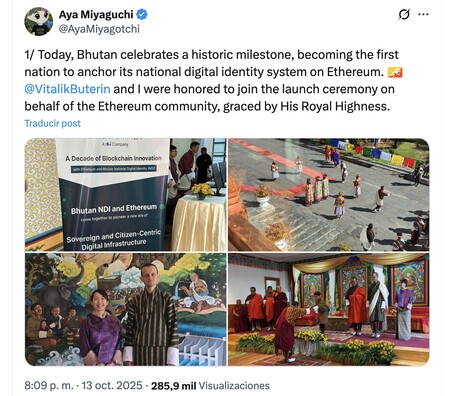
What Has Happened. Bhutan is currently in the process of integrating its national identification system with the Ethereum blockchain , the second-largest cryptocurrency by market capitalization. The switch is not just a theoretical framework; it is a real-time evolution. Authorities have confirmed that this ID system integration has already been completed. The entire migration of Bhutanese resident credentials is slated for completion by the first quarter of 2026 .
A Very Royal Ceremony. The launch ceremony of this innovative national identity document was graced by prominent figures, including Ayya Miyaguchi, president of the Ethereum Foundation , and co-founder Vitalik Buterin . They attended alongside Bhutan’s Prime Minister Tshering Tobgay and the young prince, Jigme Namgyel Wangchuk , marking a significant moment in Bhutan’s adoption of blockchain technology.
A Country Dedicated to Cryptocurrencies. Bhutan has embraced the world of cryptocurrencies for several years. The nation has been mining Bitcoin covertly in the Himalayas , utilizing its abundant hydropower resources. Currently, Bhutan holds 11,286 Bitcoin , equivalent to approximately 1.08 billion euros . This positions Bhutan as the fifth-largest holder of Bitcoin globally, trailing only behind the US, China, the UK, and Ukraine, despite its considerably smaller population of about 800,000 people.
Attempts at Other Cryptocurrencies. Bhutan’s foray into cryptocurrency isn’t new. In August 2024 , the kingdom announced a migration to the Polygon blockchain , another popular cryptocurrency platform. Prior to that, a lesser-known platform, Hyperledger Indy , was utilized. The ButhanNDI App , which is available for download in the App Store , has not been well-received, holding a meager rating of 1.6 out of 5 based on 65 reviews.

Independence and Decentralization. One of the principal advantages of integrating the Ethereum blockchain is that it offers Bhutan a degree of independence from single technology providers and centralized infrastructures. This transition significantly enhances its digital sovereignty . The official announcement emphasized that Bhutan stands to benefit immensely from the improved security, transparency, and resilience of its new identity system.
You Control Your Identity. The Ethereum organization advocates for the advantages of providing a “decentralized identity” through independent decentralized identifiers. This means that citizens can have a degree of control over their personal data, without solely relying on government databases. Such changes signify a paradigm shift in how identities are managed and verified.
But Also Risks. While the advantages are promising, vulnerabilities lurk beneath the surface. The public nature of the Ethereum blockchain raises privacy concerns . Although operations are documented through hashes and references, the sensitivity of identity systems can lead to potential misuse. Furthermore, the application of this technology could create a digital divide, as technological reliance will shift to developers and security experts familiar with blockchain systems.
Spain and Europe are Going Another Way. In contrast, the European Union has been working on a pan-European identity card for years. This “digital wallet” would encapsulate various identification documents, payment methods, and password storage in one application. Although still in development, there are concerns over privacy and security that clash with the immutable characteristics of blockchain technology. Importantly, this approach does not consider a decentralized framework, leading many to question its long-term viability.
As Bhutan forges ahead with its blockchain ambitions, it stands as a beacon of innovation. With its focus on citizen empowerment and identity management, Bhutan may pave the way for a new era of modern governance, proving that the integration of technology, liberty, and happiness can coexist harmoniously.