
“Notify when you leave and when you arrive”
Mayrit has already completed the first step. The second will occur in approximately a month when all the pieces are on Spanish soil. Mayrit is not just the youngest son of a family; it has many fathers and mothers —a multitude of contributors behind the development of a 1,500-ton tunnel boring machine .
This tunnel boring machine is set to transform Line 11 of the Madrid Metro. Until now, the line has been excavated through traditional methods, but the introduction of this gigantic machine will greatly enhance its future potential.
What’s Coming Next
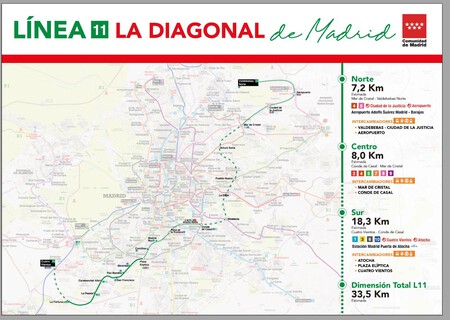
The project aims to connect Cuatro Vientos , located in the southwest region of the capital, with Valdebebas in the northeast. Line 11 aspires to be one of Madrid’s star connections, creating a diagonal path across the city. The goal is to evolve the current seven stations into one of Madrid’s major transport corridors.
With the arrival of Mayrit, a significant leap in progress is anticipated. This extraordinary tunnel boring machine is not only massive, weighing 1,500 tons and extending 98 meters in length, but it is also expected to advance approximately 15 meters each day . This is crucial for a line that will feature stations 33 meters below ground .
My colleague, Javier Márquez, noted a few months ago that the transfer of this machine is a meticulous task. Assembled by Herrenknecht AG , a renowned German company, the machine consists of countless pieces, screws, and components. Once assembled, it is disassembled into parts to facilitate its journey to Spain—a complex process that’s neither quick nor easy.
Recently, it was confirmed that the robust tunnel boring machine has commenced its journey to Spain. The pieces are being transported both over land and via sea. A major shipment will arrive in Santander by boat, with plans for ground transport to the capital. Additionally, another set of parts will arrive at the port of Valencia , having originated from Venice .
Map of the new Line 11
Upon arrival, the parts will be transported to Carabanchel , where the machine will begin drilling at a rate of 500 meters per month . This drilling will connect to Conde de Casal , about six kilometers from the starting point. Notably, this section is deemed one of the most complex to execute. Currently, the connection between Parque de Comillas , which will also have a new station, and Plaza Elíptica is being performed manually.
The intricacies involved in transporting and assembling the machine are significant, which means drilling is not expected to commence until March 2026 . This timeline reflects the extensive planning and execution required for such an ambitious project.

The working system is intricate; the tunnel boring machine’s tasks go beyond merely excavating. While making progress underground, an auger transports the excavated material through a conveyor belt. Depending on conditions, this material can be washed if it encounters mud and may require additional support through injections of bentonite , water, or foam. Simultaneously, sensors monitor the pressure experienced, ensuring optimal work efficiency .
If everything follows the outlined schedule, the final piece from Mayrit should arrive by December , but operations to begin drilling aren’t anticipated until March 2026 . For the time being, traditional methods like shoveling and using pneumatic hammers will continue.
Overall, the enhancement of Line 11 represents a significant investment in Madrid’s transport infrastructure. With the arrival of the Mayrit machine, the city is bracing for a transformative leap, reinvigorating its public transport system and accommodating the growing demands of its citizens.