
The Ambitious Stad Ship Tunnel Project: A Gateway for Norway’s Maritime Future
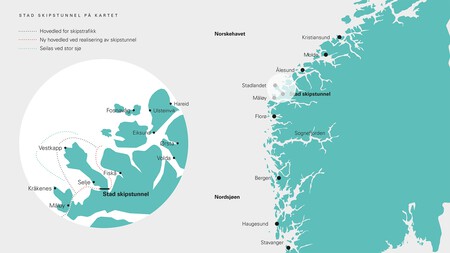
Norway’s stunning coastline, with thousands of kilometers of sinuous terrain and a blend of turbulent currents and extreme weather, presents unique challenges for maritime navigation. Daily, sailors transport goods, fish, and passengers, but many face perilous conditions along Norway’s coast. This has spurred discussions on ambitious infrastructure improvements, particularly focusing on the Stad Peninsula . The proposal to build a nearly two-kilometer tunnel specifically designed for boats offers a potential solution, yet it is mired in challenges, primarily escalating costs.
What is the Stad Ship Tunnel?
The concept of a boat tunnel may seem unusual, yet it aims to create the first underground passage specifically for ships in history. Stretching approximately 1.7 kilometers in length, the Stad Ship Tunnel is designed to accommodate vessels as tall as 50 meters and wide enough to allow safe passage for larger maritime traffic. Located in the Vestland province of western Norway, this ambitious project would require between four years of construction work and is considered essential for improving navigational safety.
The Need for Safety and Efficiency
Why is there a pressing need for the Stad Ship Tunnel? The peninsula is notoriously treacherous, known for strong winds and rough seas of the Stadhavet Sea. Without nearby islands to offer protection, it is a hotspot for maritime accidents. Research indicates that the nearby Kråkenes station records more stormy days than anywhere else in Norway, often exceeding 100 storm days in a year. The proposed tunnel could significantly reduce travel time and enhance navigational safety, making maritime transport more efficient and reliable.
A Historical Perspective
The idea of a tunnel under the Stad Peninsula is not new; proposals date back to the late 19th century . Initial concepts aimed at creating a railway pipeline through the landmass, evolving over the years into the current vision for a maritime tunnel. It wasn’t until 2013 that the project gained traction in the National Transportation Plan, sparking renewed interest in addressing the challenges faced by maritime traffic in the region. Despite rigorous feasibility studies and land acquisition efforts amounting to more than $30 million , significant hurdles remain to be resolved before construction can begin.
Escalating Costs: A Major Roadblock
The tunneling project’s ambitious nature is matched only by its exorbitant cost . Initial estimates placed the cost at $325 million , but inflation and technical complexities have pushed this figure to a staggering $690 million in 2023. Recently, it has been reported that expected costs could balloon to $780 million , raising concerns about financial viability. Norwegian Prime Minister Jonas Gahr Støre hinted at shelving the project, citing the need to prioritize funds for essential public services such as health and defense over infrastructure initiatives.
Public Reaction and Future Prospects
The public and industry stakeholders have expressed frustration at the halt in progress. In a recent statement, the Norwegian Coastal Administration confirmed that the Government had decided to “suspend” the tunnel works pending parliamentary deliberations. Over 500 companies from the fishing and shipping sector, along with other stakeholders, have rallied for the tunnel’s construction, claiming that it represents a major opportunity for economic growth and job creation.
However, the discussion is far from over. The Center Party and other factions in Parliament have echoed sentiments for continuing the works, indicating a possible coalition to revive the project. As debates intensify, the future of the Stad Ship Tunnel remains uncertain. Each twist and turn in this saga highlights not only the technical complexities involved in tunnel construction but also the political and financial maneuvers that accompany large-scale infrastructure projects.
In summary, while the Stad Ship Tunnel promises to enhance Norway’s maritime landscape significantly, economic considerations are bringing the ambitious project to a standstill. The outcome will depend on the evolving dialogue within Parliament, public sentiment, and the ultimate decision on where the country’s investments will be best allocated in the coming years.