
Qiyunfang Unveils Revolutionary EDA Platforms at Bay Area Semiconductor Expo
A company called Qiyunfang recently concluded a unique presentation at the Bay Area Semiconductor Expo held in Shenzhen, China. During this event, they introduced two innovative Electronic Design Automation (EDA) platforms that promise to pave the way for China’s technological independence in semiconductor design, a domain previously dominated by American companies.
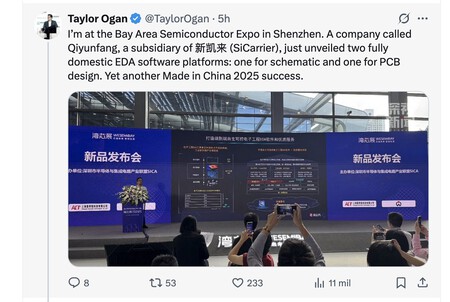
Understanding EDA: The Backbone of Chip Design
But what exactly is EDA ? Electronic Design Automation (EDA) software is a crucial tool in the semiconductor industry, serving as the bridge that transforms engineers’ chip design concepts into executable plans for manufacturing. This segment has long been dominated by American companies such as Synopsys, Cadence , and Mentor Graphics/Siemens EDA , which provide essential services for translating design ideas into workable blueprints—enabling manufacturers like TSMC and SMIC to produce these chips.
The Rise of Qiyunfang: A Game Changer in EDA
Qiyunfang, established in 2023 , is not just any tech company; it operates as a subsidiary of SiCarrier , which collaborates closely with Huawei Technologies . To add to its influence, SiCarrier is a semiconductor manufacturer backed by financial support from the Shenzhen government . This triple-layer relationship positions Qiyunfang as a formidable player in the semiconductor ecosystem.
The US-China Technological Tensions
The geopolitical climate adds urgency to Qiyunfang’s innovations. In May 2023, China’s decision to block the export of its rare earth elements prompted a retaliatory move from the United States , effectively cutting off American EDA companies from offering software solutions to Chinese clients. This denial placed immense pressure on the Chinese semiconductor industry, as having the necessary factories means little without the ability to design chips. For instance, SMIC has been using Synopsys EDA design suites for over two decades until they abruptly lost access due to the sanctions.
A New Avenue for Self-Sufficiency in Chip Design
Qiyunfang’s newly introduced solutions are designed to provide in-house EDA software capabilities that handle both schematic designs (conceptual) and PCB layouts (physical board designs). What sets these platforms apart is their Chinese software stack , which encompasses the operating system, databases, and middleware—crucial elements for achieving technological independence .
The Pursuit of Technological Independence
If these EDA solutions prove effective, they could secure China a technology stack immune to external sanctions and fully integrated into its national technological ecosystem. The ongoing trade and technological warfare between the United States and China has ignited a race for self-reliance in critical sectors. The strategy resembles a culinary approach: “I’ll grow it, I’ll cook it, and I’ll eat it,” reflecting China’s resolve to reduce dependency on foreign technologies.
Challenges Ahead: Advanced Chips Remain Elusive
While the introduction of proprietary EDA software is a significant advancement, China still faces a monumental challenge in creating advanced processors that leverage cutting-edge technologies like 3nm and 5nm photolithography , using EUV techniques. Current developments in advanced chip manufacturing are ongoing, but until these capabilities are fully realized, Qiyunfang’s platforms stand as an excellent alternative for designing more mature chips that cater to critical sectors such as automotive and industrial applications.
China’s Vision for Semiconductor Technology
This recent development aligns perfectly with the aspirations outlined in Xi Jinping’s “Made in China 2025” plan, which seeks to empower the nation with control over pivotal technologies like artificial intelligence, robotics, and, most critically, semiconductor manufacturing. The unveiling of Qiyunfang’s EDA platforms represents a notable milestone in China’s journey toward technological autonomy, suggesting a future where dependence on external technologies is significantly diminished.