
For almost any country in Latin America and the world, a company like OpenAI announcing a multi-million dollar investment sounds like a golden dream . It is not only the most influential company on the planet in artificial intelligence , but also one of the pacesetters in the industry. Its arrival promises jobs , economic movement , and global visibility . However, as with any large-scale project, it raises doubts about energy consumption , water usage , and the sustainability of a data center consuming hundreds of megawatts. Argentina , at least on paper, has been chosen to attempt that leap.
The announcement of the Argentine Government rests, at this point, on a single document: a letter of intent signed between OpenAI and the local company Sur Energy . The text, published on October 10, 2025, mentions an investment of “up to $25 billion ” for a data center of “up to 500 megawatts ,” under the Incentive Regime for Large Investments (RIGI). The location of the project is not specified nor are deadlines or construction phases detailed, which keeps it in a preliminary stage.

<span>The Argentine president met at the Casa Rosada with representatives of OpenAI last week</span>Silences that weigh. Notably, a multimillion-dollar announcement linked to the expansion of OpenAI in the region has neither its CEO nor the company itself communicating it through their official channels . While this does not invalidate the project, it creates a noticeable distance from the institutional enthusiasm on the Argentine side. In such operations, communication typically forms an integral part of the message, which is conspicuously lacking, at least from the American startup on your website and social networks.
The plan: AI factories at scale. *Stargate * is not an isolated project; instead, it is part of a global infrastructure initiative by OpenAI. This program aims to construct a network of data centers capable of supporting cutting-edge artificial intelligence models , which power technologies such as conversational chatbots and image generators . For OpenAI, these models are the backbone of products like ChatGPT , employing systems like GPT-4 or GPT-5 . This plan gained momentum several months ago when the company announced an ambitious infrastructure project in the United States , followed by expansion into additional countries.
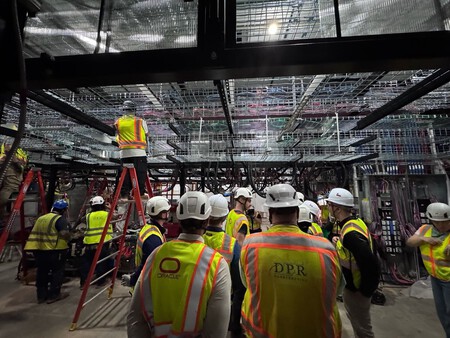
<span>Interior of Stargate 1, the first large-scale data center developed under OpenAI's program</span>Power, density, permissions. Data centers exclusively catered to artificial intelligence operate under different parameters . These facilities concentrate massive GPUs with industrial-level power demands and energy density significantly higher than conventional data centers. Each operational area requires advanced cooling systems to maintain optimal temperatures consistently. Although permits and licenses are necessary, the scale and technical requirements make these projects more complex and lengthy to build.
RIGI and financing: promise vs contract. As mentioned, the project is underpinned by the Incentive Regime for Large Investments , designed by the Argentine Government to attract foreign capital through tax, customs, and exchange advantages. While the RIGI facilitates financing for large-scale projects, it does not ensure that the investment will indeed materialize.
Patagonia sounds loud, it’s not official. There is no specific location mentioned on paper; the Argentine Government has not voiced any specifics regarding Patagonia . However, the name of the local company involved, Sur Energy , fuels the notion that the project may be developed in the southern region of the country.

<span>The president of Argentina, Javier Milei, with the CEO of OpenAI, Sam Altman, in May 2024</span>Climate and design: allies or burdens. Strengthening the idea of the southern location rests on a technical argument: the climate is favorable. Colder regions permit operations with less cooling energy, utilizing outside air , thus reducing costs and emissions. Water availability remains a decisive factor . Aware of potential risks, new artificial intelligence campuses are adopting cooling systems that minimize water use. The final option OpenAI will choose remains to be seen.
When the network or the water say no. The data center’s location does not simply hinge on weather or tax perks; factors such as the electric grid and water availability can determine a project’s success or failure. For instance, while Mexico is a major tech hub in the region, a Microsoft facility faced national grid limitations and resorted to gas generators. Similarly, Chile saw Google’s plans thwarted due to excessive water usage, underscoring that adequate infrastructure is critical.
<img alt="The evolution of technology and its impact on resources" width="375" height="142" src="https://i.blogs.es/c854f2/cemrecan-yurtman-ox5dv5qd3-8-unsplash/375_142.jpeg"/>From exclusivity to autonomy. Historically, OpenAI’s infrastructure heavily relied on Microsoft . Following a $1 billion investment in 2019, Microsoft became its exclusive cloud partner. Over time, this partnership expanded, exceeding $10 billion , solidifying Azure as the primary platform for training and executing models. Nonetheless, OpenAI has sought greater operational autonomy . The Stargate program is designed to establish its own computing resources, thereby diversifying technological dependence.
From paper to concrete. At present, the initiative’s future hinges on the next steps. For the project to progress, a definitive contract between OpenAI and Sur Energy, as well as environmental studies and electrical interconnection licenses , are essential. Financing schemes and long-term energy agreements will also have to be solidified. Only once these components are in place can this initiative shift from a mere announcement to a tangible reality .
Images | Xataka with Gemini 2.5 | Government of Argentina | Javier Milei (X) | Sam Altman (X)
In Xataka | There is a new technology gold rush in Spain, driven by data centers